“Not all heroes wear capes … mine just happens to drag his feet,” Justin Lee told me with his signature smile as we passed from the sunshine of Kona into the mist and rain of Waimea on the big island of Hawai’i. He was talking about his father, Wade Lee, who I would come to find out was regarded kind of like the Godfather on the island. Everyone knew him. Everyone rolled the aloha carpet out for him. As Justin’s Tundra climbed the winding, glistening roads of the volcanic west coast of the island, he explained that his father’s limp was the result of too many cases of the bends during his time as a commercial diver. Wade Lee has lived many lives, all more interesting than most, but who’s counting besides the IRS anyway?
I was joined on this Hawaiian-style safari by filmmaker and MH International Editor Byron Pace and long-time collaborator Ben Lizdas from Swarovski Optik. For five days, we shadowed Justin and his family to the ends of the island with all sorts of cameras. The end result was to be a short documentary on the Lee family and their forest restoration project that focused on native Hawaiian koa and sandalwood trees, the latter of which is a subspecies only found on the western slopes of the big island. The film, set to release in early 2025, had only begun to take shape when I realized that the light meter on my 35mm Nikonos underwater camera was broken. As Justin rattled off picturesque filming locations, my hopes of underwater photos faded faster than the mist in the ever-strengthening tropical sun. I would have to use the sunny 16 rule. (At least I learned one practical thing in photography school).
We arrived at Justin’s home in Honoka’a and were greet-ed by his two young children — his daughter Elle, and his son Pa’akai. I was introduced as “Uncle Tyler,” as were “Uncle Byron” and “Uncle Ben,” and that was what we were called for the remainder of the trip. I would learn later that it was not just a formality; we were considered family from that point forward. Pa’akai ushered me to his room, where, it turned out, I would be staying. Bunk beds, hell yeah. Between the Star Wars toys, Marvel action figures and a sticker that he had slapped on the wall, undoubtedly from one of his father’s many ambassador care packages, which read “Don’t rock this boat TOO hard,” I felt right at home.
We unpacked as best as we could with-out smashing stuffed animals or Resistance starships and readied for the first order of business: spearfishing. More family was coming over for dinner tomorrow, and Justin needed to procure some finned protein. He spoke of it nonchalantly, like he was simply going to the grocery store for eggs. We were not getting eggs, we were going freediving into the depths of the doorstep ocean. To the man many know as J Lee, who regularly stands on the podium at national spearfishing tournaments, it was routine. After quickly checking the weather, we headed to one of his many local spots that promised the calmest surf and wind conditions.
As we neared the coastline, we drove past abandoned campsites with ocean views and leisure anglers with no lines in the water until the red volcanic soil transitioned to black lava rock as abruptly as you might expect from a violent geothermal explosion. In fact, it didn’t transition at all; we were just suddenly parked on a moonscape. “Careful,” Justin said, “this stuff is really sharp and can pop tires and rip up your sandals.” Good thing I was wearing sandals that were basically made of tires.
Justin casually geared up for spearfishing like he was going for a jog in the neighborhood, while Byron prepped his filming gear as if heading to the front lines of some far-forgotten African conflict zone, as he of-ten does. I chuckled to myself about watching him become more and more of a “prepper” over the years we have been friends. He excels at providing an obscure tool that someone might need.
“Hey Byron, you don’t happen to have one of those specialty mini star-shaped screwdrivers, do you?” I asked. He snapped to attention and said with a pride that only the few who know him well could observe, “Too right I do.” I didn’t really need it, but I knew he would enjoy passing the test, so I tightened the screw on my folding knife anyways.
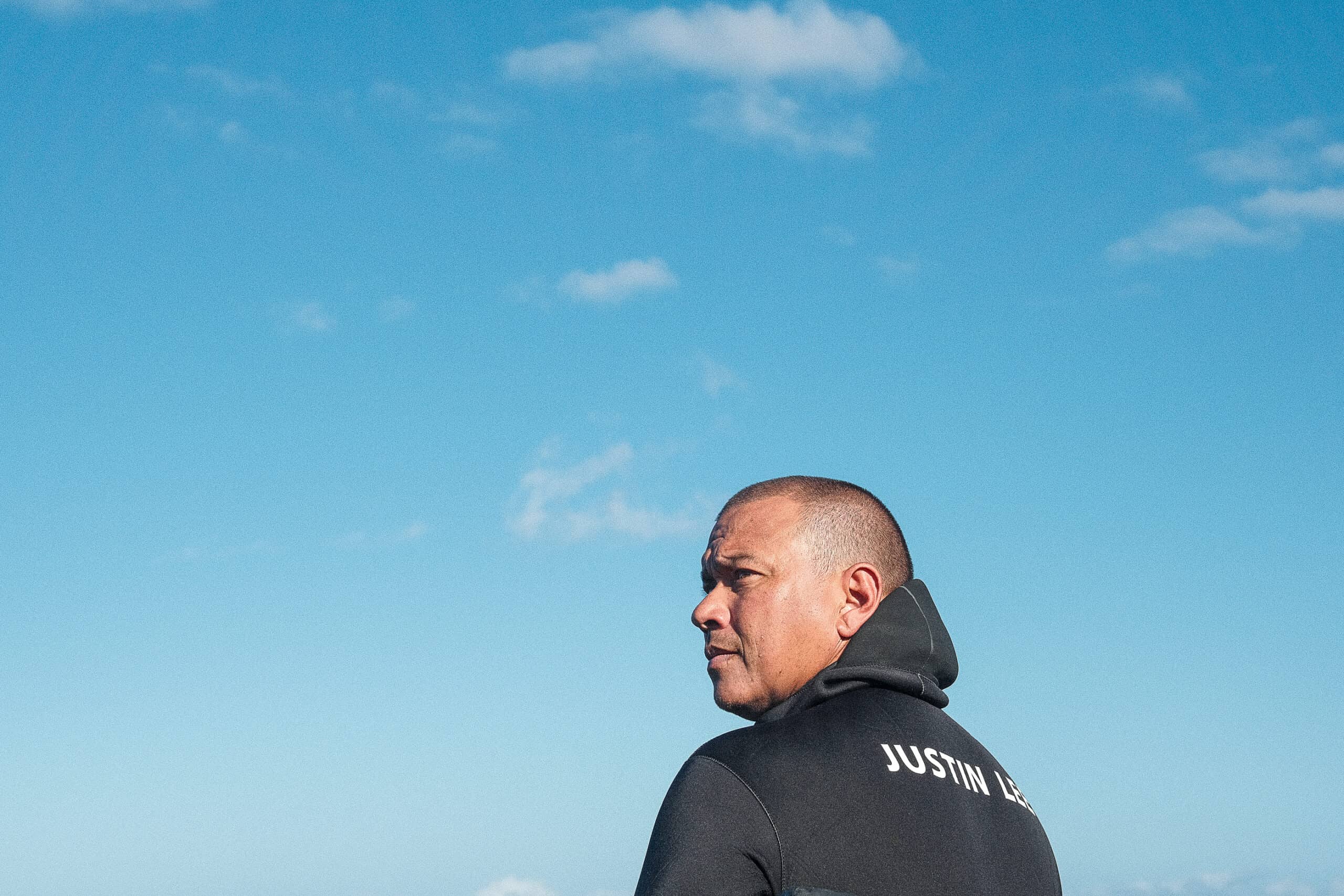
With our protagonist fully suited up, complete with his competition wetsuit bearing his name on the back, and Byron grinning ear to ear at the chance to put his new underwater housing to use, we stalked carefully down the chasms and mires and pitfalls of a volcanic crag to avoid an opening-day leg gash and subsequent urgent care visit — that would come later in the trip. Justin stopped to point out a patch of dried sea salt that stood stark and white against the black lava rock. “My son is named after this … Pa’akai, which means salt water, made solid … the physical form of the ocean. Pretty cool, huh?” I immediately tasted some. Damn, I thought, that is good. I could make some mean margaritas with that. I filled my bag with what I could for a party trick I would reveal later in the hopes of earning an upgrade from just “Uncle” to “the cool Uncle from Texas who made us kickass margs with from sea salt that our youngest is named after.” It’s important to have goals in life.


They jumped in, and I followed. As I submerged, I felt like several years’ worth of stress and anxiety had been immediately washed away by the healing Hawaiian salt water. Circumnavigating my broken light meter as much as possible, I shot a few frames underwater as Justin and Byron swam fathoms farther and faded into the deeper hues of the great blue wild. I swam back to shore, dried in the sun, and watched Justin floating on the surface farther and farther away with each pull of the moon’s might, ever hovering like an aquatic bird of prey watching its quarry below. It didn’t take many dives for him to accomplish his mission. As he returned to shore, Jus-tin’s dive belt glimmered with a scaled radiance of the fishes he’d speared that seemed to fade with each wave that hit the shore, like a kitchen timer signifying the transition from free swimming to food for the family. The grocery run was complete, and for me, the weight of the world was washed away.
We returned to Justin’s home to the buzz and aroma of Lao food being prepared, which was music and a melody to my hungry ears. Justin’s wife, Sonnaly, is a first-generation Laotian American, and her parents were also there for dinner. Beautiful, kind and patient, she welcomed us into her already busy home as if we’d just returned from an overseas trip that went too long without writing to share that news. She asked intentional, genuine questions about our lives and seemed to not even blink with distraction as she listened to our jet-lagged answers. I was amazed at how calm and sincere she was amid the quickly growing chaos of family, friends and other kids showing up. With a husband as adventurous, spontaneous and in demand as Justin, who is called away from home often, it could be no other way. You must let a migratory bird like Justin Lee fly, which she does gracefully. The result is a soothing calm that everyone who crosses the thresh-old of their door — after you take your sandals off — can feel. We were home, and Uncle Tyler was already dropping hints about post-dinner margaritas.


Elle and Pa’akai helped clean the fish, wielding the fish scaler with ease and evident practice, and Justin had them identify the organs and various entrails through the process. Each moment was an opportunity to teach them about their food, why it’s important to know those things and to give thanks to the ocean. I learned no such lessons as a child and had no way to show appreciation to Mr. Kraft or the Schwann’s man or to give thanks to wherever Rice-A-Roni came from. Contrasting with the suburban childhood many of us had, this was the way it should be, the way it was meant to be, and it was beautiful.
More family arrived. Uncle Gil showed up with his famous poke. Best on the island, I was told, which was solidified by a recent competition win. Justin’s father, Wade, among many others, arrived, and they cooked up a storm. We ate family style, which felt like the first family dinner I’d had in nearly seven years. My family is some-what estranged, and while I know I am not alone in that reality, as families are inherently messy and tumultuous, it has created a massive hole in my life. It took me years of work to move past the turmoil, and a few days a year, it still seeps through tightly cinched cuffs and collars. You can’t choose your birth family, but realizing you can make and choose your own has allowed me to move for-ward in my own life. Eating that night, I also realized that you can be chosen as family by good people like the Lees. It was a beautiful night, and to my surprise and delight, it was the first of several family dinners during our stay. But as I said before, I was not trying just to be “Uncle Tyler,” so I broke out the sea salt, fresh lychee and guava that we had picked on the way home and showed them how we make margaritas where I come from. They were a big hit, but I did not share the recipe in case I needed a reason to be invited back.

Where were we? Oh yes … filming a documentary. The next day, we checked out a few of Justin’s local hunting spots for wild pigs, which are a meaningful part of Hawaiian culture. By checked out, I mean Justin rode his e-bike with a compound bow and a speargun strapped to it to scout a few pieces of land he had permission to hunt on. After hearing a few stories at family dinner about him rolling around the neighborhood with a dead hog on the bike rack and a line of cars behind him because the e-bike didn’t have enough power to go up the steep hill at the posted speed limit, I had the realization that Justin is kind of like the neighborhood cat that kills and eats absolutely everything but is so sweet to everyone that nobody holds its predatory instincts against it — that is, as long as they’re invited to the barbecue. That day, however, the wild pigs were spared from Justin’s prowling.
Neighborhood spectacles aside, the crowning jewel of the Lee family legacy is the forest restoration project called Haloa Aina. It’s not a ranch or a farm but more of an enchanted forest high above the clouds that represents the family’s spirit and dedication to not only the Hawaiian way of life, but also conservation, stewardship and sustainability.
Starting in the 1850s, beef was a major commodity in the middle of the Pacific Ocean, which led many land-owners to cut down trees in favor of cattle operations — slash-and-burn type stuff that left the land depleted and the old-growth forest vanquished. It has been the Lee family’s mission to restore the forest on their several thousand acres of land. It’s such a massive part of their family that it is lovingly referred to as “the fourth child” beyond Justin and his two brothers.

We spent three days exploring the forest, learning about their planting strategies for koa and sandalwood trees, the dynamic relationship between those two species, and what is re-quired for them to thrive there. Beyond the sandalwood and koa, there are 15 other species of trees that they raise in their nursery, which help round out the health and diversity of the forest. Justin and his children planted several trees together, speaking a Hawaiian phrase over them as they did, which translated to “If you survive, we survive.” Byron planted one, too.
We also learned about the project’s challenges and successes. In short, it has been incredibly successful, and they have measured an increase in precipitation of 22 inches over the 15 years they have been planting due to the koa tree’s sick-le-shaped leaves, which capture the sea breeze mist every day and drip that down to the soil. That is not to mention the other benefits, such as increased biodiversity, improvement of microclimates and the return of rare native bird species, among other things. Being there with Wade was like walking around in a massive Zen garden with the master monk gardener who knew every tree, blade of grass and rock crevice where a seedling could be planted.
On a quiet afternoon, sitting under a canopy of mature trees that whispered in the afternoon breeze, he told me, “Even though we are on the most isolated land mass in the world and we’re talking about planting trees that we’ll never see mature, it feels like we are doing something incredibly important. Possibly the most important thing there is in life: caring for the environment around you. It’s getting in touch with your spiritual side — your soul.” I was left speechless, so
I let the trees answer for me. Wade’s sage words could not be truer; you can feel that at Haloa Aina.


Drive up a mountain to reach the forest, and the world falls behind. As you transfer through the high-mountain mists, you seem to leave part of your waking, rational self be-hind too, and enter a dream state, closer to the heavens and closer to your true self — closer to who you should be and are meant to be. It is an incredibly peaceful place that allows you to take deep breaths, which is what the Hawaiian word “haloa” means: long breath.
The best part of their story is that they have found a way to sustain the operation by harvesting dead or dying sandalwood trees to produce high-quality, highly coveted sandalwood oil. A processing facility on the premises chips the wood, granulates it to even finer dust and then uses pressurized steam to distill it into pure oil. As you can imagine, it smells incredible, which is why I dragged my leather camera straps on the ground in a few areas where excess had spilled during the extraction process. Conservation has many forms, and I was doing my part to ensure it went to good use.


Haloa Aina sandalwood oil is highly sought after by many for essential oils, aromatherapy, and religious and ceremonial uses throughout southeast Asia. The demand for and sale of the oil helps sustain the project, the forest and, in turn, the Lee family. “Take care of the land, and the land will take care of you,” Wade often says.
In the eyes of the Lee family and the larger context of Hawaiian culture, for that matter, the land and forest are part of the family; thus, they work together to care for it. After the last trees were planted and the sun sank behind the mists that will bring moisture tomorrow, Justin turned to me and said, “Ohana means family … and no family gets left behind.”
With that mantra as both a promise and a reminder, I left Haloa Aina knowing that despite past losses, my family had grown by not just a dozen humans but thousands of trees as well.