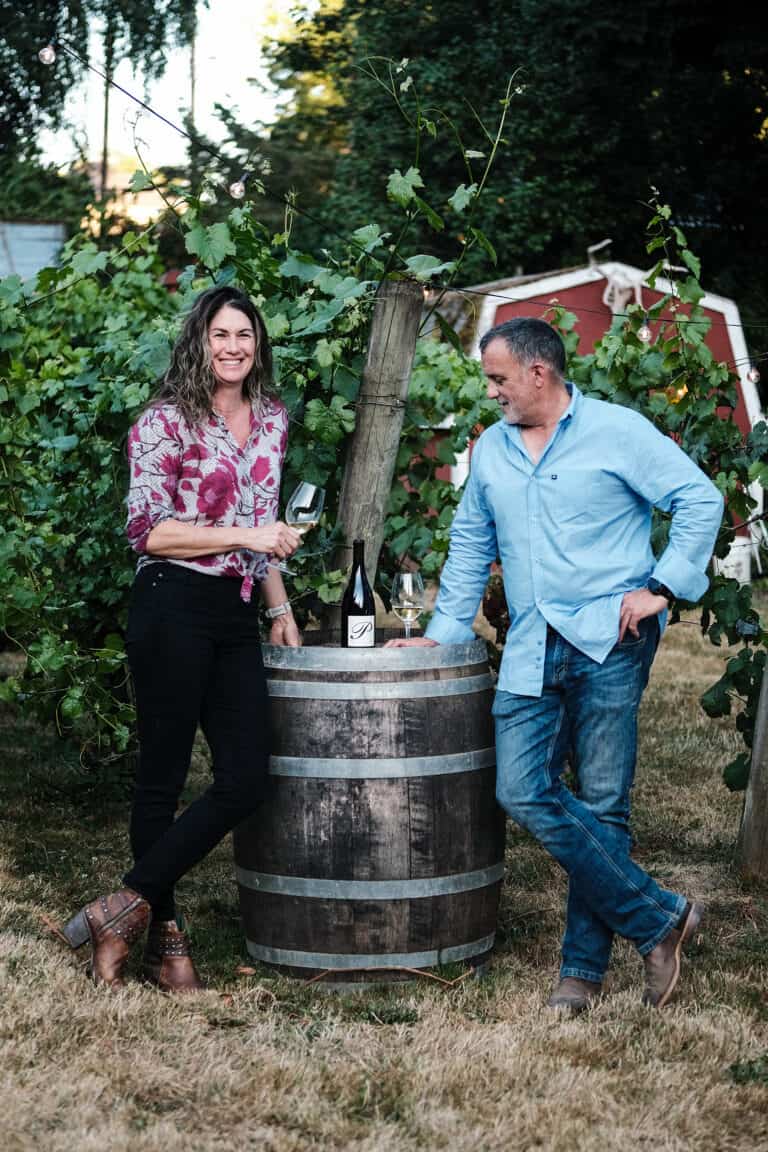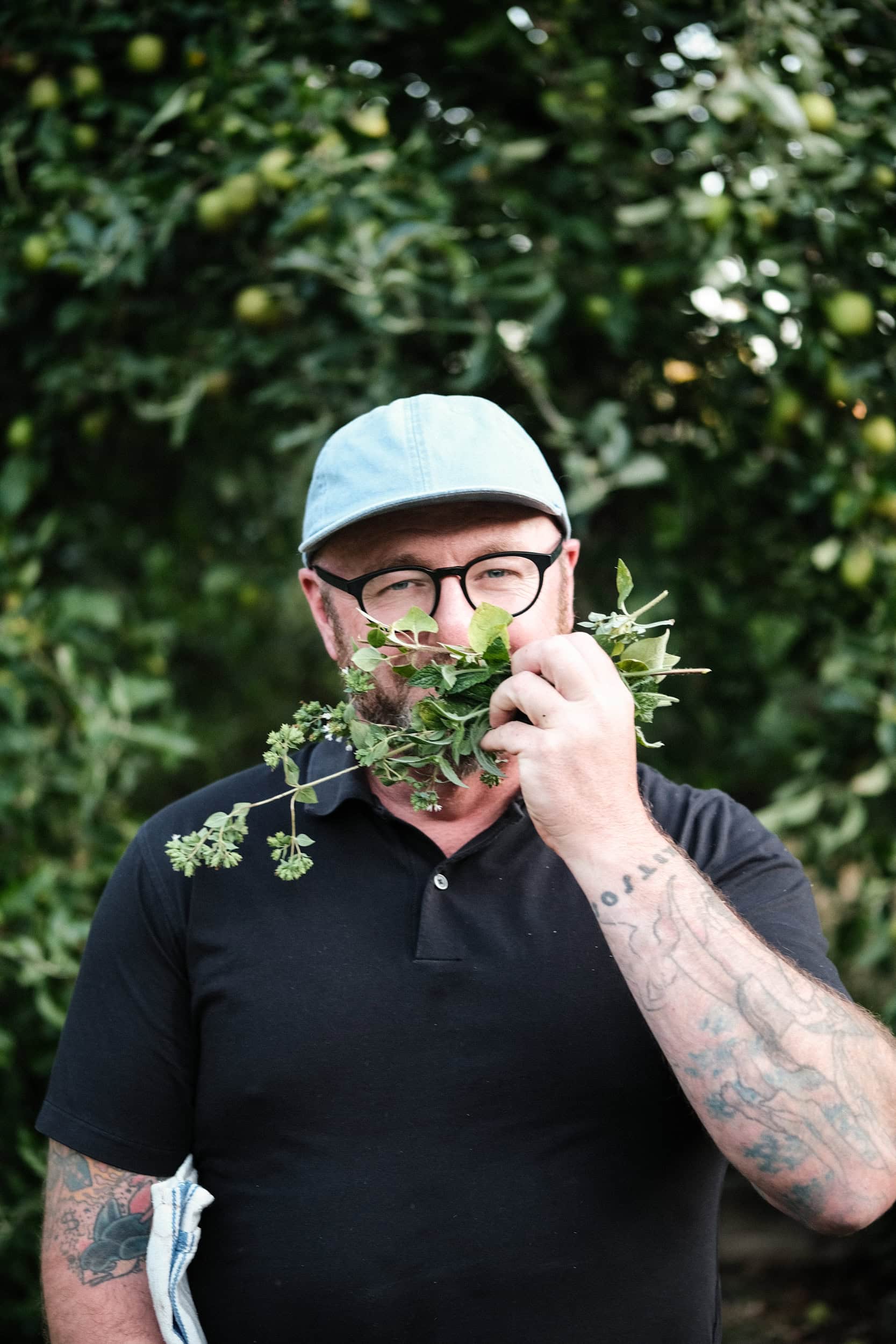
It was a poor decision on my part to let my daughter and her friends decide whose Käsekrainer they preferred. This Austrian sausage — generously studded with Alpine cheese — is a flavor softball: fatty, perfectly spiced and, as I mentioned, containing cheese. I thought I had this in the bag as a professional sausage-maker myself, but I was wrong.
The exemplary Käsekrainer made by my friend and peer, Elias Cairo, was the clear winner. But if I had to lose to anyone in the world, it would be him. Talent as a cook might actually be one of his lesser qualities, and he’s fiercely talented. He is an adroit outdoorsman, caring, methodical and joyous in his approaches to West Coast elk, chukar and cutthroats. His restaurants are lauded not only by customers, but most importantly by the people that staff them. His garden produces jaw-dropping volumes of food, which is good because he serves likewise gargantuan portions at backyard dinners.
With so much going on in his present world, it is necessary to ask about his history, an almost Munchausen-esque culinary journey that’s completely true. I sat with him over a perfect latte (he is also my favorite barista) on a perfect Portland morning after a perfect Oregon night and asked him to tell me his story, again.
Jesse Griffiths: Your origin story is something that I repeat to other people, or I try to — I don't know if it's accurate. I probably romanticize it, but I don’t even know if you can because of the magnitude of it.
Elias Cairo: My father was Greek first generation, from the Peloponnese; he passed away when I was 15. He was one of those unbelievable human beings that built everything. We had a Greek American restaurant, huge gardens, and we’d hunt, fish and raised all of our own animals. When he died, the whole family just kind of collapsed. The garden didn’t get planted, and it just shattered my mom’s life for a while. I spent some time getting in trouble at school, and she encouraged me to take up snowboarding to at least do something productive or get out of her hair. I got sponsored by Burton Snowboards and was put on tour, but after a year of stupid stunts that left me concussed and scared, I realized I didn’t love it.
What I really loved was working in my mom and dad’s restaurant. I loved cooking around the family. So I told my mom I wanted to try the chef life, and she said, “If you’re going to go back to Europe, you should go learn how to cook Greek food. Go to your dad’s village, go to the islands." But I doubled down on wanting to go someplace where I could learn “fancy” cuisine.
My mom called her church, and they said they knew somebody who knew somebody in Switzerland, a woman named Annegret who just had an apprentice who hurt themselves. I sold everything and got on an airplane to head to this little tiny mountain village in the wintertime, called Wildhaus.
I knew I was probably crazy, giving up snowboarding for learning how to cook. But I got a ride up the hill to this frozen mountain hotel and started my stay in employee housing that looked out into the middle of the Alps, the Churfirstens, seven mountains. My first full day on the job I woke up and strolled into the first walk-in freezer I could find, looking for Annegret, and instead found a whole ibex hanging with its head still on in the cooler.
Come to find out, Annegret and her team worked with Bjerger, a big hunter in the valley and the local Jäger —the game warden, if you will — up in that area. If you shoot an animal over Tokenberg, you have to bring it here to check it in, and Bjerger’s going to offer you three ways to cut it, pack it, wrap it, then turn it into sausage and utilize what we can throughout the restaurant.
Right then and there, I started the apprenticeship. I was 16, a high school dropout. It was supposed to be for six months, and at the six-month mark, I said to Bjerger, “I know I’m illegal. I don’t care. I’ll do anything to keep this job.” He’s like, “You’re going to get me in so much trouble.” And he just turned around and walked out. He didn’t say no, though. So I kept showing up to work.


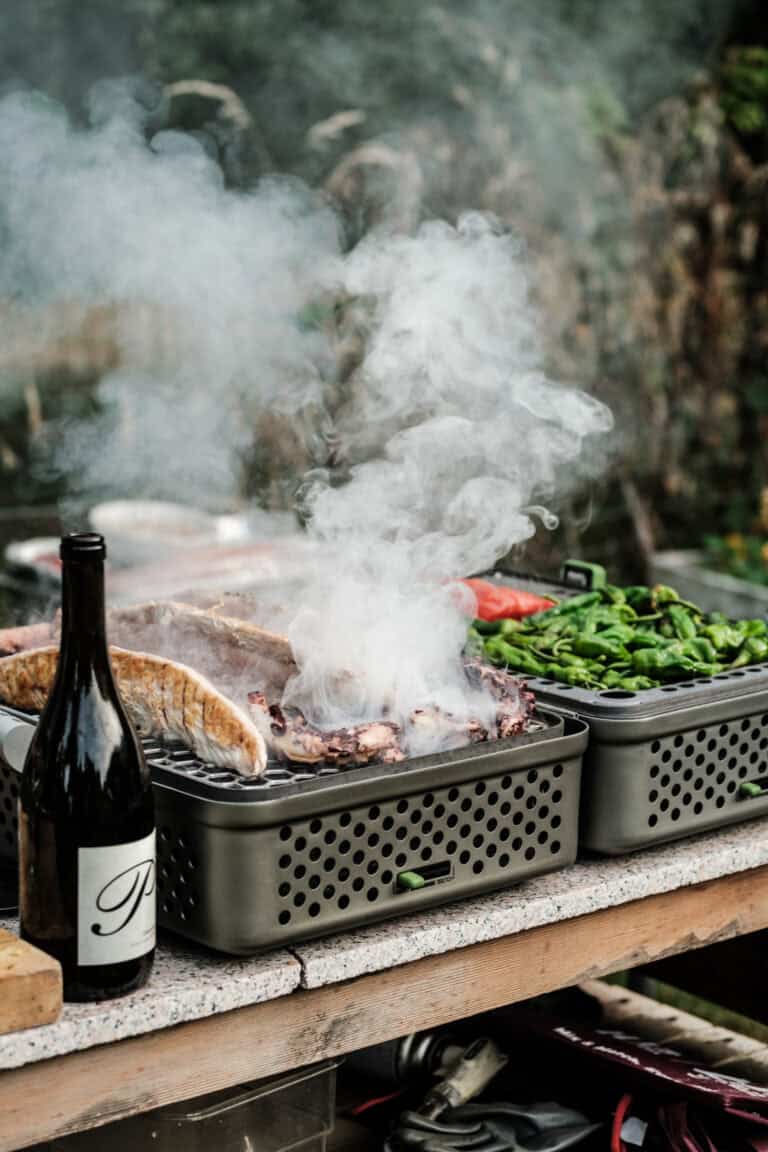
My neighbors across the street were cheese makers, I think it was a fifth-generation farmstead cheese. They let me milk cows, and I’d help them move hay and rotate cheese and such. I never knew you could do that for a living. And I just kind of stowed it in the back of my head — I knew that was important.
Two years into it all, I asked Annegret if there was any way I could go to culinary school. She said to “go ask Bjerger.” And I was like, “Fuck.” Bjerger’s an intimidating human being, a very serious, rule-following, unbelievable human being. I started walking up to Bjerger’s office and I got about halfway, turned around and went straight back to Annegret and said, “Bjerger said yes.” He’s a pretty busy man too; I figured he wasn’t going to notice. So they sent me to school. After four and a half years in total, I finished with the Swiss apprenticeship with a full culinary degree.
At 22 years old, I finally moved to Greece to cook because it was always in the back of my head that maybe I made a wrong decision starting in Switzerland. So I moved to a little Greek island where I cooked in a huge hotel, whole animals. It was like a fancy-ish hotel, but still very, very Greek where I went from, how do I say this … Switzerland, if you made 100 gallons of bouillon, you counted every piece of clove. Everything was just so dialed in. And then I walked into my first day as a professional Swiss-trained cook to a Greek kitchen where I don’t think they even know what a recipe is. And it was just chaos, four cooks feeding 300 people three times a day. And when fish would come in, it was pallets of fish. When lamb would come in, it was just legs, packs of meat, and beans were in buckets.
JG: On the chaos-to-precision scale, where are you now?
EC: I would say I would not be where I am without my Swiss training. Running a USDA meat plant is very chaotic, and it’s so important to be super focused, organized and understanding of the importance of role. But I think the biggest thing I learned from the Greek kitchen is that passion and community is very important. Even though it was completely chaotic, there was loud Greek music playing, there was lots of laughter, and it was very, very, very, very, very hard work — but it was a very loving place. We’d go five, six months without a break. There were people there that went years without a day off, we’re talking decades of just cooking every single day just to make it work. Those were the people that made that environment so loving.
One day I’m mopping the floor in the Switzerland kitchen. I slid on a snowball and I caught my fucking hands on a French top. It instantly puffed up on the bottom of my hands. There I was, convinced I was about to lose my apprenticeship, having to go to Annegret and explain how I couldn’t even bend my hands they were so badly burnt. And they just looked at me, put marmot fat on my hands, strapped gloves over it, taped the gloves down and then said, “Go butcher, you’re just working in the wild room until you can start cooking again.”
So I get in there and it was one of those perfect days. We had six elk, four marmots, bunch of rabbits, copa, a chamois and then a Steinbuck. It was a lot of work for just three of us. It was hard work, but nobody was yelling or stressing and I just loved it.
I told Jäger how much I loved it, and how I really wanted to cut more meat. “Yeah, you should go work kill in the village,” he said, and I went and learned to kill veal and all sorts of animals. And then I’d go to another sausage maker in another village, and then on my days off, I just became obsessed. I still didn’t have a clue what the hell I was going to do.
JG: On the chaos-to-precision scale, where are you now?
EC: I would say I would not be where I am without my Swiss training. Running a USDA meat plant is very chaotic, and it’s so important to be super focused, organized and understanding of the importance of role. But I think the biggest thing I learned from the Greek kitchen is that passion and community is very important. Even though it was completely chaotic, there was loud Greek music playing, there was lots of laughter, and it was very, very, very, very, very hard work — but it was a very loving place. We’d go five, six months without a break. There were people there that went years without a day off, we’re talking decades of just cooking every single day just to make it work. Those were the people that made that environment so loving.
One day I’m mopping the floor in the Switzerland kitchen. I slid on a snowball and I caught my fucking hands on a French top. It instantly puffed up on the bottom of my hands. There I was, convinced I was about to lose my apprenticeship, having to go to Annegret and explain how I couldn’t even bend my hands they were so badly burnt. And they just looked at me, put marmot fat on my hands, strapped gloves over it, taped the gloves down and then said, “Go butcher, you’re just working in the wild room until you can start cooking again.”
So I get in there and it was one of those perfect days. We had six elk, four marmots, bunch of rabbits, copa, a chamois and then a Steinbuck. It was a lot of work for just three of us. It was hard work, but nobody was yelling or stressing and I just loved it.
I told Jäger how much I loved it, and how I really wanted to cut more meat. “Yeah, you should go work kill in the village,” he said, and I went and learned to kill veal and all sorts of animals. And then I’d go to another sausage maker in another village, and then on my days off, I just became obsessed. I still didn’t have a clue what the hell I was going to do.
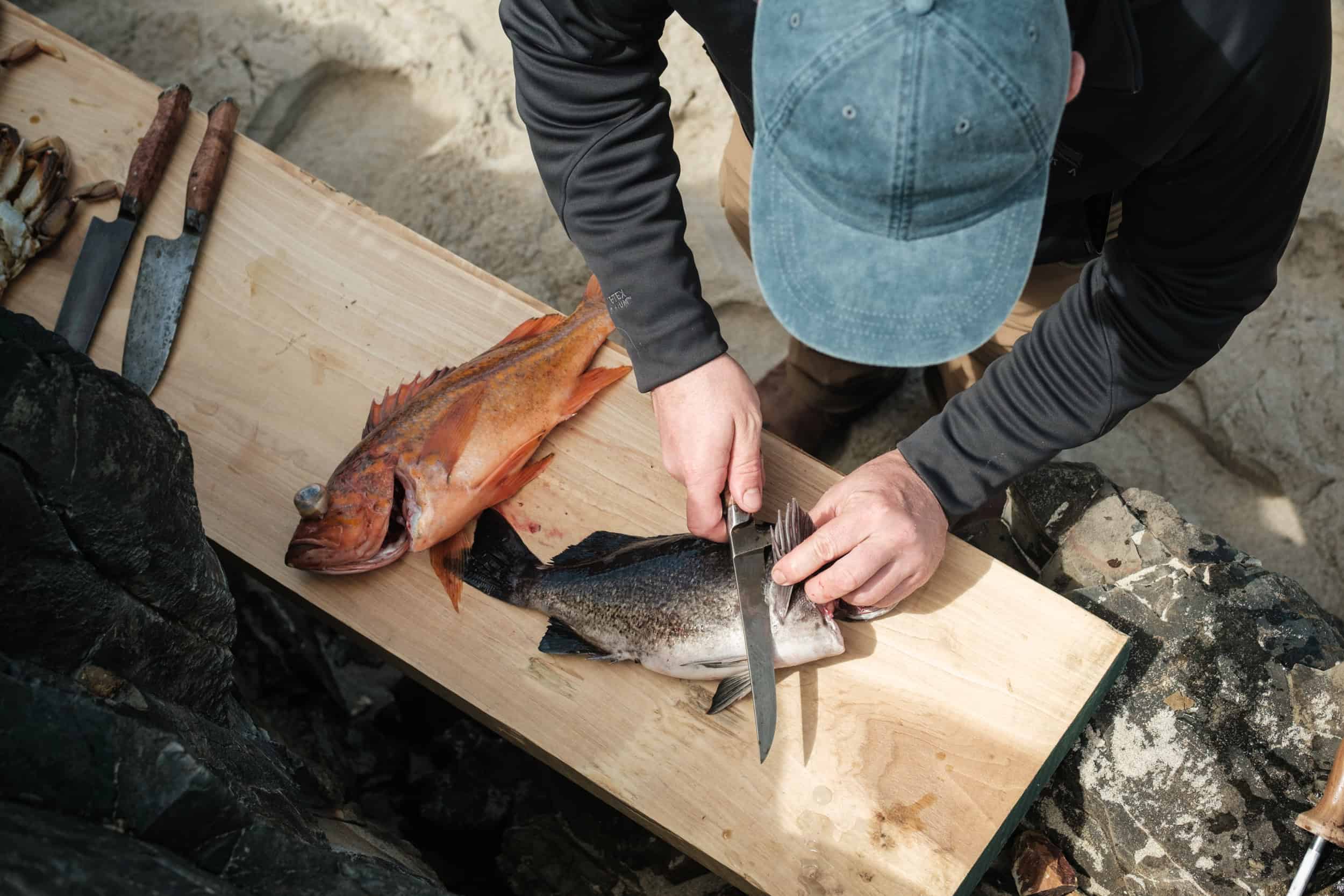
JG: Let’s go back to your childhood. Your childhood, the hunting component and the butchery component, then how much you had already learned about all that as a kid.
EC: I would say I learned quite a bit. The Swiss, when we would cut animals, the famous saying is, “It has to be cleaner than your teeth.” You can't waste anything.
With my dad, we would raise 100 pigeons a year just for meat. And all that part of my life was just amazing. When I think about fishing with my father — we would go smelt fishing in harvest canals where he would drag nets up and we would just get so many little tiny fish to fry. Everything we did was based around food and cooking and making spirits or fermenting wine. It was just like every single day. I could freaking string up a sheep as a little tiny kid on my back patio and knew how to tie it onto a spit real easy, which is kind of fun.
My dad and I, when we were cutting up animals, we were doing it very rough. That was eye-opening for me. I knew back straps are tender without much effort, don’t forget the tenderloin on a lamb, so on and so forth. We used a lot of hatchets, which you still do.
JG: I used cleavers. Were you hunting as a kid?
EC: Yeah, yeah, for rabbits and birds. And my dad hunted big game. But I can never, ever remember antlers in my house, you know what I mean? It was always just like, “Look, your dad and his buddy went out and there’s a cow elk in the garage and we have to figure this out.” And I can remember riding around, but I can never remember the conversation being like, “God, I need a big mule deer.”
JG: That’s significant. There were antlers in our house.
EC: And fishing, again, it was harvesting. When we’d go fishing, we’d go to rural canals and drag nets up it just to get some. We’d go catch carp, anything we could get buckets of. And when we’d go rabbit hunting, we would get endless amounts of rabbits and would be frickin’ making loukaniko sausage with rabbit and pigeon.
JG: Making sausage out of rabbits and pigeons?
EC: Yeah, we’d make loukaniko, this Greek sausage — it’s seasoned with garlic, cumin and some sort of citrus herb, just really pulled flavor out of any meat we had. There’s definitely not a recipe for that bad boy.
JG: Was there any hunting in Greece?
EC: Oh yeah, big time, but not where I was on the islands. I guess spear fishing is what you would call it, but I wouldn’t call it what it is today. We had a rubber band, you know what I’m talking about?
JG: Hawaiian Sling.
EC: Yeah, exactly, yeah. And that was it. I could just snorkel and do that any second I had off and I could run to the beach any moment. And I was still very obsessed with climbing at the time too, so I was kind of trying to balance it all. But at that age, you just go. I’d wake up at four in the morning before anything to get into the ocean to try to swim, knowing I had to be work at seven.
JG: Okay, so post Greece, what happened?
EC: I fell in love with this Lichtensteinian gal. I was trying to decide if I was going to move back to America. I was living in Graubünden, steepest valley in Switzerland, working in a few little butcher shops when Michelle [my sister] called me and said, “Man, you’re going to love Portland. Everybody I talk to talks about wine, hefeweizen, coffee, cheese, you name it.”
So when I finally visited, she took me instantly to the farmers market, and I couldn’t believe: the crazy heirloom tomatoes, wild potatoes, fresh smoked salmon … There were farmers talking about organic lamb, it was unbelievable. Then there was this huge line around the corner for this guy, I bet you it was like 40 people in it, making cheese. I had to wait in line. It was Rogue blue cheese, a very famous southern Oregon cheese maker here. It was real blue cheese, pungent, smoky and gooey.
I made Michelle stop by Whole Foods, and I tried American salami and I was like, “Where is the display of charcuterie? Where is the mole? What is happening?” I went and tried the ham after eating European ham, smoked ham with real meat, and I was like, “This tastes like corn syrup and sadness and shit.” It’s just like, what are we doing here? So I told her, “I’m selling everything. I’m going to move back. I’m going to make a meat company.” This was before I had any clue about the USDA, whatever it was. I was also still very, very broke. Remember I did my apprenticeship, worked in Greece, was still trying to figure it out, and Michelle paid for my ticket home, and she’s like, “Live in my basement.”
I became a chef of an amazing restaurant here called Castagna, which couldn’t have been a better landing place for me. It was perfect because they dealt with all the foragers and cheese makers and farmers and made it just a beautiful, beautiful kitchen and an environment that was very much a family. This was probably 2005 at this point, somewhere in there, where I started building my first fermenting cooler and then Charcuterie, the book came out, the world-famous one that I read.
JG: Michael Ruhlman?
EC: Yeah, exactly. Ruhlman’s book came out and I was reading it and was just enraged. I was thinking, “What do you mean? You don’t dice a capricola or a coppa. There’s just so many flaws in that.”
JG: I know exactly what he’s talking about.
EC: “You’re making saucy sauce without nitrate?” And I was like, “What do we do? You’re going to kill people, this guy doesn’t know the science of it.” So then I started tasting a few salamis in America. There’s one up here called Salumi, and they were selling it with live active molds. I finally got ahold of the USDA in 2007. I told them how I wanted to ferment my meat naturally, slow souring and cover it in live active mold, never cook it, never heat process it, and sell it. At first their response was, “Yeah, no, that’s just not something that’s possible.” They finally agreed to meet us, and we pitched the food science Michelle had been researching on how we were going to make salami. That was 2008, when the economy sucked and meat plants and restaurants were going out of business, so the USDA finally relented and agreed to work with us to make it happen. Then in 2009, we opened up the first salami shop in the history of the state to legally ship meat over state lines.
JG: You were telling this story about waste the other day, how you would quantify the waste in pigs. So if X pounds of pork was wasted, then you would acknowledge that, “And that’s this many pigs,” but you had to kind of back away from that. Will you expand on that a little?

EC: Yeah. When you’re making charcuterie and working in that factory environment, I feel like there’s a potential to turn these amazing animals into widgets. And at some point people were being just a little flippant about that this was an animal and a farmer brought this to the market and so on and so forth, and took the life. I’d always take them to the kill plant. And that’s really impactful for somebody that hasn’t seen a lot of pigs being killed. That was the first step to it. I think it’s very, very important for people that are cutting meat all day long and stuffing sausage to understand that.
Now it’s way more rewarding, because I take team members down to the farmers raising our pigs now, and if they get to go out to the farm and see the families that they’re impacting, it’s enough. Everybody understands that it’s changing what we’re doing in the Pacific Northwest with pigs, and there’s a lot of pride in it. I’m very lucky with those employees right now. I couldn’t be more thankful.
JG: Talk about the Farmers Network a little bit.
EC: Yeah, absolutely. Farmers Network is the hardest thing I’ve ever done in my entire life.
It’s trying to change the inertia of what responsibility to animals looks like in agriculture in America. This is going to be an uphill battle forever. People don’t understand that meat can be used in a way to benefit the land that they’re farming. Right now it’s just people torturing animals to get it out to the market at the lowest cost possible, doing whatever they have to do, not thinking those animals deserve any respect, right? 99% of all pork raised in America is in confinement.
There’s no way you can look at that and feel good about it. Those animalsare tortured. Their ears are clipped off, their teeth are clipped off, their tails are clipped, they’re not allowed to turn around, they’ll never see daylight. All their waste is going to hurt the environment through septic ponds or culturally because people have to work in there. Vegetarians and vegans are 100% right.
That’s not the way to bring meat to market in America. There is a way to do it, but you have to change the way that labeling and the transparency of meat in America is done, and that’s what we’re trying to do. I’m trying to show that America can have a meat company that is completely transparent and can use pasture-raised small family farms that are using animals to benefit their land, and that is either going to ruin my company or make it stand alone.
That started in 2009. And on the back of it too, Polly and I, we’ve always said we want to make the best cured meats in the world, not just America. And if you think about where those are done, Iberico pork, you’re thinking of pasture or small pork producers in France and Switzerland valleys and all these amazing regions in Italy that have the greatest farming practices. They you have to start with animals being treated well and building muscle tissue and developing depth of flavor.
And Polly and I knew that we needed to get animals that are running around in fields to change that standard if we really want to find nuances. We’re not going to get fresher ground spices, we’re going to move the dial a little bit there, we’re not going to get better technique. I mean, we’re always pushing ourselves toward that, but no matter how good we get at that, you got to start with something really, really good.
Something like 95% of people can blind taste a quality piece of pork, pasture-raised. Imagine trying to get better at what you’re doing without starting at the source.
JG: It’s unbelievable. I mean, you’re producing an astronomical number of sausages. Do you still make sausages here at home?
EC: Yeah. I’m back on making pâté for family and friends when they come over because I just think it’s the ideal thing to make. It just shows people that you really, really care for them when you make these treats. And you can use all of the offal and all the ground meats and nuts. What I think is unbelievable about when you start processing more wild meat around here is how much more difficult it is. I can make any kind of beef and pork sausage be enjoyable in my sleep, but every single elk and deer and all that trim and wild game and turkeys and everything, to make that into delicious charcuterie, be it a pâté or sausage? I’m learning every single time. It’s different fat contents, different funkiness. There’s just a lot to it that’s different. I’m sure you feel that. You do it on such a crazy scale at your restaurants. But it fascinates me. I remember last year I made parsley pecorino sausage. If I’m making sausage at home, I’m usually taking fresh Italian parsley, grating pecorino romano and black pepper and raw garlic and a little red wine, and I grind it three times and then case it.
JG: I’m kind of disappointed in myself as I’m about to use a phrase that’s going to be in print, but I’m going to say it: making pâté is a love language.
EC: A pâté, it’s definitely the least amount of machismo that a cook can have in making food for their family. When people say, “I want to make sausage out of my fucking elephant,”
I’m like, “Man, you want to make a cool thing that’s going to blow people’s mind when they come over to your house? Learn to make meatloaf really, really good that you can serve cold.” It’s about enjoying yourself and taking a step back. I’m lucky enough now to hunt with some really burly human beings, like Purple Heart Marine special forces guys, and I’m more than happy to bring a pâté, and they are so into it.
JG: And it’s notable with the abundance and the amount of meat that you’re around, dozens of hogs from these beautiful farms, and you’re still extracting every single bit from every single animal that you’re personally coming in contact with. That’s pretty incredible.
EC: In the Farmers Network, the only way it makes very, very fine, thin margins is that I sell pet treats, and I always found that I’m still that charcuterie maker, I’m a value-added meat maker. I take bone, I take skin, and I take offal that we can’t sell at the same price, and I grind it and I sell pet treats to be truly adding value to that animal.
JG: What’s the percentage utilization that you get out of a hog?
EC: Not counting blood?
JG: From the carcass that enters the meat plant.
EC: The meat plant? Yeah, it should be 100% if I’m doing it completely. Completely in my world, there should never be any waste. If it comes to my door after the lungs are out and the blood sucked away, the offal, kidneys and everything, it should be 100%.
JG: Just for the record, is that common in meat plants?
EC: I mean, every meat company would like to, but they’re not built flexible enough. As my company grows and we’ve been able to get more sustainable, I could see the impact that I can have on the meat industry of bringing higher quality products for people that I like and companies and farmers that are doing it the right way. And that’s going to be really, really cool. I think it’s going to be amazing that I’ve spent my whole life making meat, trying to make the best meat I possibly can, and then finally bring it to markets with companies, farmers that I respect. That’s just what we do.

JG: Same thing is happening in your home with your elk?
EC: Yeah.
JG: Why do you think at one point in this country, specifically this country, because I think that it’s the outlier, that we moved away from not only needing to utilize that, but even wanting to utilize that much from an animal, even though there’s so much effort put into either the enjoyment of domestic animals and raising them or hunting and fishing. Where do you think that we went wrong?
EC: That’s a really, really good question. Where we went wrong? It’s tough. I think there’s part of me, when I get back to when I’m in my dad’s village in Greece, it always dawns on me. America really just wanted to be filled up quickly and easily and became very texturally worried. They didn’t want to slow-stew shanks. They wanted steaks, and they didn’t like offal for whatever reason, and they lost the palette. The vast majority of America, I felt, lost the palette not only in taste for unique things, but also textures and the work that goes into making something better, right? They didn’t want to eat an old turkey because the legs are too chewy, and you’d throw that thing away, where in Greece they bring the whole family along.
In America, it’s like somebody gets a chewy fricking turkey leg, it’s the last time they’re going to eat it. And you’re just like, “Take two minutes and figure out how to fix that problem and make it something unique.” JG: How do you fix that with hunters? What’s the slow road to changing the mindset around utilization and enjoyment?
EC: What you guys are doing with this Wild Food series and these cookbooks, you and MeatEater, you’re all bringing it to attention that there’s more to hunting for your food than a backstrap and a breast. You guys are slowly but surely changing the conversation. A lot of hunters out there, they may not come from the food world, but are very interested in the food process side of it. I see a lot of people that five years ago didn’t know how to make sausage, wouldn’t want to build a smoker on their farm or anything. Now how many people are aging meat on carcass to get it more tender? So many.
JG: Do you think that there’s a way for hunters to adopt this more old-world mindset? What, in your opinion, is the biggest roadblock?
EC: I seriously would have to say it has to do with just personal interest in a palette. I really, really do. I don’t think that a lot of Americans are interested in trying to taste things that blow their mind, in cooking really, really fascinating things from interesting animals. They just want it to be easy and bland.
JG: If it was one word, it’s interest.
EC: Interest and drive. Focus and passion. It’s hard. It’s harder to make very delicious things, but you have to recognize it’s more rewarding. It’s so easy to salt a pot roast, but if it sucks, try to make it better. You’re going to learn, slowly but surely, to get better at cooking and utilizing, and then that’s just more weapons in your toolbelt. You’re going to become a better all around human for it. I mean that’s just the drive, the internal drive to make it better. It’s so fascinating. I’ve told you my carrot story. Please tell me I’ve told you my carrot story with Annegret Stilff.
JG: Tell it again. I know I'll remember halfway through. I came into the kitchen in Alp Arash and was just hungry as hell and Annegret was peeling carrots.
EC: So I walked over, grabbed a carrot and threw it in my mouth. She just stared at me and asked, “How did it taste?” I said, “What do you mean? It tastes like a carrot?” She then said one of the most profound things, something like, “I could teach you every trick in the world about being a chef, how to slow cook, how to braise, but from here on out for the rest of your life, everything you put in your mouth, if you taste it and think it can be better or just be fascinated by it, and you correlate your brain to how that thing tastes, you will be a better chef than anybody in the world.” I was shocked. “Wait, what? You’re not supposed to just eat to fill the void when you’re hungry? You should always taste like that?” And she went on this rant where she talked about how all waters taste different and how you should always take the time to taste. I walked away from that with the realization that to be a chef, to work with food, you need to taste everything. Even when I’m really hungry out hunting and think, “Fuck, it’s time for a KIND bar,” I try to pick out every single nut in there. That has always stuck with me. If you’re going to become a cook or a chef or a charcuterie producer, anything that’s going in your mouth has to fascinate you. You’re interested because every little nuance is different. You have a chance to learn something and find something. It can be exciting every single day.
Better in Print
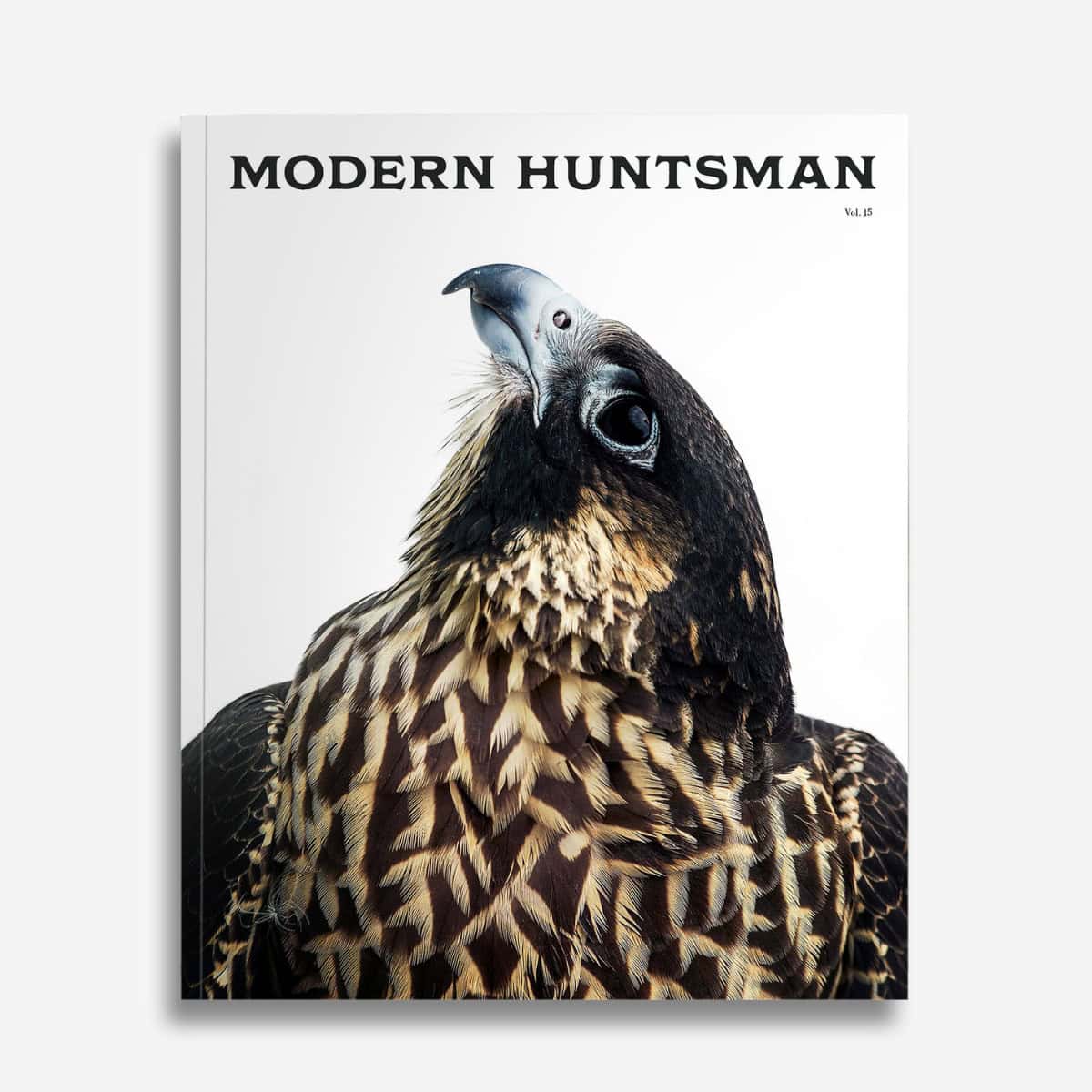
224 pages of stories, photographs and artwork from the field.
You can purchase this volume standalone, or start your membership and save.
As a member, you’ll receive 20% off back issues, free shipping, exclusive behind-the-scenes content, automatic entry into giveaways, and so much more