
Legend has it that Texas troubadour Steve Earle once declared his friend Townes Van Zandt to be “the best songwriter in the whole world.” By today’s standards, such hype sounds pretty tame, especially given its placement on a promotional sticker for one of Van Zandt’s forgettable studio albums. But Steve Earle being Steve Earle, he followed up his proclamation with that unforgettable qualifier — “and I’ll stand on Bob Dylan’s coffee table in my cowboy boots and say that” — and the legend was born, one whose poetic marriage of bald-faced bravado with the tragic romance of the West feels, in substance and in style, inextricably Texan.
While we’re making bold declarations, here’s a couple more: John Graves is not a Texas author, and Goodbye to a River is not a Texas book.
For those of you who know neither writer nor work, such a statement must sound about as threatening as a squirt gun. For the Lone Star literati, however, many of whom grew up reading Graves from grade school onward, I might as well have just challenged them to a duel. So be it. They can’t help where they were born, and besides, I can’t blame them: if I was from Texas, I’d fight to claim Graves, too. But before the posse comes out to the corral a’jingle-janglin’ in their spurred Noconas, hear me out. For I mean not to insult Texas or Texans but to properly celebrate Graves and his book.
The problem is that those who write in admiration of Graves seem honor-bound to stand him up beside a trio of Texas literary lions — Dobie, Bedichek and Webb — and thereby define him not for who he is but for who he is not. He also commonly gets compared to Thoreau and Hemingway, two looming presences in Goodbye to a River who serve as philosophical sparring partners for Graves. I won’t make such comparisons here. Graves’ prose is too masterful, and his book too damn good, to be reduced to mere resemblance. Thus, I bluster
Goodbye to a River is not a Texas book; it is an abiding work of literary art, one that, like its author, just so happens to have quite a bit of Texas in it.
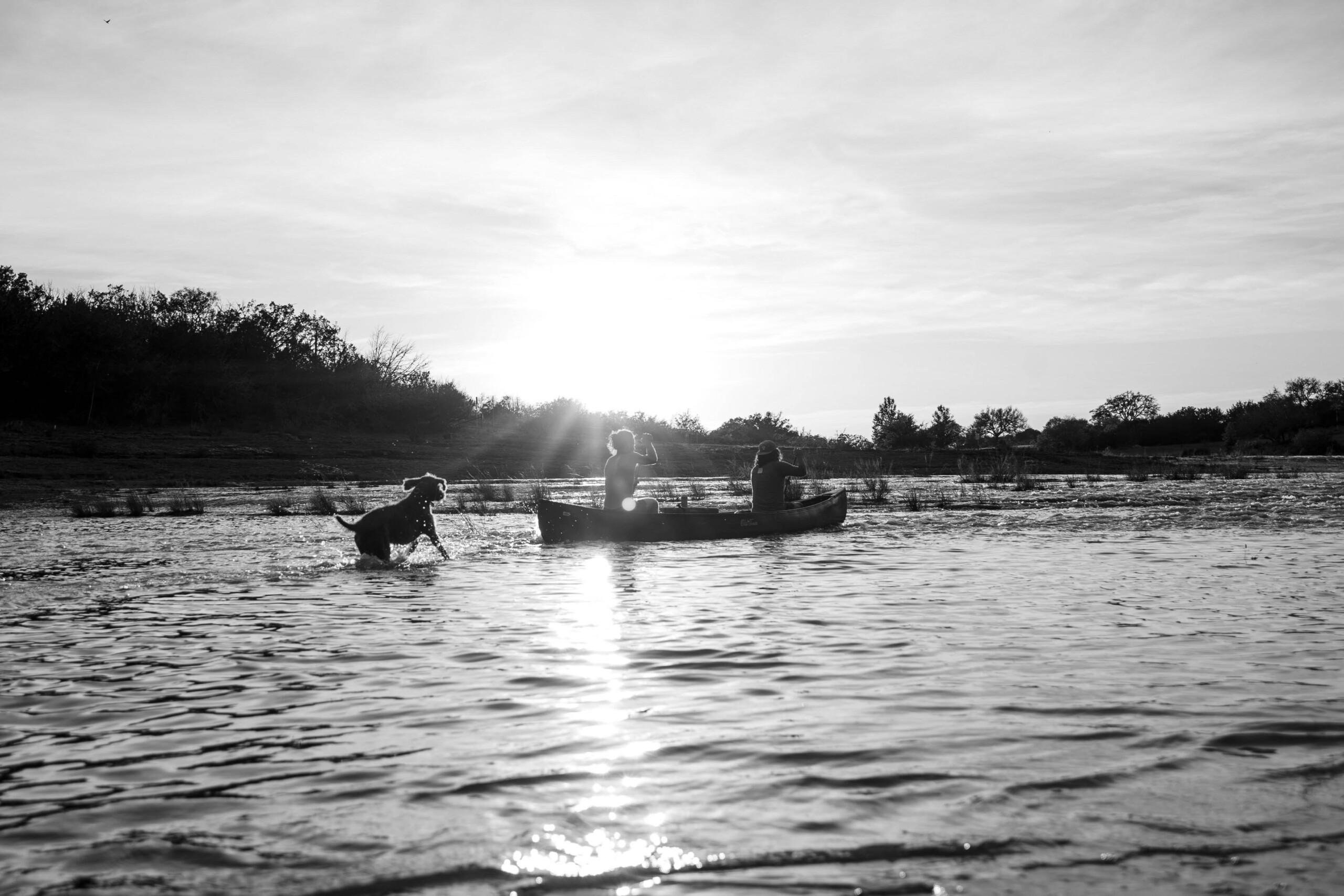
Specifically, the Brazos River, or at least the stretch of it that meant enough to Graves to compel him to paddle the length of it, alone, one last time before a series of proposed dams would turn his beloved river into a series of reservoirs. Even more specifically, “A hundred and fifty or two hundred miles of the river toward its center on the fringe of West Texas, where it loops and coils snakishly from the Possum Kingdom dam down between the rough low mountains of the Palo Pinto country, into sandy peanut and post-oak land, and through the cedar-dark limestone hills above a new lake called Whitney.” His piece of the river, he calls it — and by the end of the book, it feels like the reader’s piece, too.
Graves’ three-week solo canoe trip constitutes the book’s primary narrative. Along the way, local characters he meets and wildlife he encounters prompt a riveting intellectual meander through literature, philosophy, and what we might call natural history, or conservation, though Graves himself would likely take those terms to task. He is the best of guides: saturated with knowledge, devoid of arrogance or shame, and fully armed with confidence, a bone-dry wit, and impeccable comic timing. He is also that rarest of writers who can lead a reader deftly through, say, the thickets of Texas history — from the two bloody centuries of plains-based Comanche wars to the post-World War II recreational “Chris-Craft and tinkle of portable radios” of Graves’ own day — without vilifying or glorifying any one person, people or way of life. The histrionic rhetoric of preachers, politicians and similar polemicists is not for Graves, clearly. His art of persuasion is more old-fashioned: a slow, graceful accumulation of trust. You come to agree with him less through the strength of his argument than through the beauty of his prose.
In addition to a dachshund pup he calls “the passenger,” Graves totes along a shotgun and shells, a rod and reel, and a trotline — but he does so halfheartedly. One day, he shoots a squirrel for supper. Another day, he hooks a catfish and cooks it over a campfire with some beans. If you come to this book looking for some kind of textual analogue to your favorite hunting television show or survivalist Instagram feed, though, prepare for disappointment. It may indeed be a tale of one man’s adventure in the wild, but there is no peddling of suburban escapist fantasies here. “Hunting and fishing are the old entry points into nature for men,” Graves says prior to cleaning the catfish, “and not bad ones either, but as standardly practiced these days, for the climactic ejaculation of city tensions, they don’t go very deep.”
True to style, Graves undercuts his own bold declarations before the reader can so much as raise their hackles. “Reverent” is the word he settles on to describe the mindful act of killing. “To see and kill and pluck and gut and cook and eat a wild creature,” he writes, “all with some knowledge and the pleasure that knowledge gives, implies a closeness to the creature that is to me more honorable than the candle-lit consumption of rare prime steaks from a steer bludgeoned to death in a packing-house chute while tranquilizers course his veins.”
So, not a Texas book, and not a hunting or fishing book either, but one with plenty of all three rendered in elegant prose. What’s more, Goodbye to a River contains both the single best sentence ever written about a river and the best last line of any book I’ve ever read. Will I boot scoot across Shakespeare’s coffee table and proclaim John Graves to be the best writer in the whole world? No, I will not. But only because a writer so original, and a story so compelling, would suffer from any comparison. Some authors deserve to stand alone.