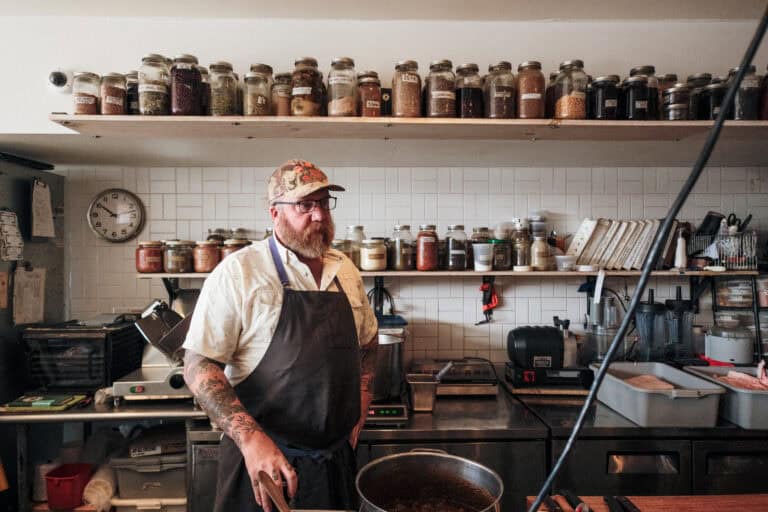
There’s always a bit of anticipation and apprehension in hero-meeting, but Yia Vang quells those feelings within moments. Direct, talented, capable and communicative, he is an anomaly in the hunting and cooking world, and utterly fascinating. His story — obviously recounted many times before — reflects a familial history fraught with sadness, violence, nurturing and success. His connections deepen our own; his story is just one of millions that should be regarded as a fundamental American story. His family fought communists and survived years in a refugee camp before moving to America, and excelled through grit and their wells of agricultural knowledge.
Yia’s path is hard to condense into a few pages, but it always inspires curiosity and determination. I sat down with him before turkey season and on an empty stomach. A couple of hours later — or was it minutes, or half a day? — I emerged with a greater appreciation of Hmong culture, my own roots, the individual significance of hunting, how food is the common conduit for empathy, and that more meals should have four components.
Yia Vang: I tell people I never wanted to get into cooking. Cooking, for me, was just a means to an end. Growing up in a Hmong household, you always had chores to do.
My dad would work the first shift. My mom would work the second shift. My dad was a carpenter. My mom worked at these factory jobs. When we kids would get home from school, Dad would say, “Hey, could you help out with dinner?” I hated washing dishes as a kid. The rule was if you cooked in the kitchen, you didn’t have to wash dishes, so my reply was always, “I’m in.” My dad would teach me, “Here’s the pork, cut it this way. Cut the vegetables and then start frying things up.” Mom always made sure we knew how to make rice. Then we would make sure that we made enough food for Dad to pack the next day for him to go to work. It was just life. It was just simple.
Our family owned a butchery. I grew up out on the East Coast for a little bit, in Pennsylvania, Lancaster County, Amish. There’s a small Hmong group there. We are very agricultural people. Instead of cartoons, cereal and baseball at the YMCA, we visited the local farms. Growing up, I didn’t know anything different, so I thought this was just normal. Going to an Amish farm and harvesting pork or beef or chickens was just a Saturday morning for us. A lot of times, when people see what we do, they think it comes from a beautiful, romantic story. But it was just survival. It’s just what we had to do.
Eventually, it became this idea of: If I’m going to spend my life doing this, if I’m going to put my heart into this, I have to ask myself, “What is my why? Why am I doing this?” My dad was an incredible storyteller when I was growing up, and I think there was a part of that that sank into my heart. I say, “I love telling stories, but I don’t use pen and paper. I use ingredients.” For me, it’s very clear. The story I want to tell is about my mom and dad and their legacy. We get to do that where we are right now at Vinai.
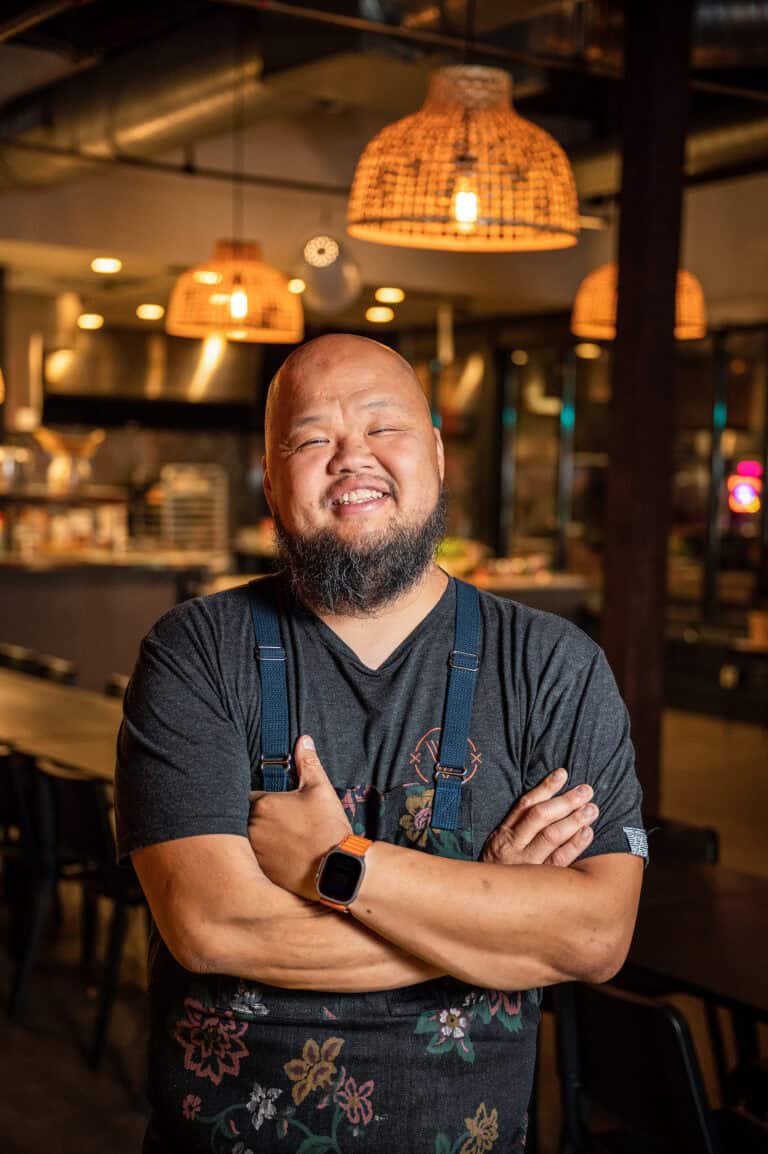
Jesse Griffiths: I think you and I are unified in our hatred of doing dishes and how it propelled us down the path of cooking instead, because it was the alternative. That’s not a non-romantic start to it. Going to Amish farms in Pennsylvania from such a young age; then you come from such a distinct culture and move into another one. Both of these realities are joined together by this connection to ingredients. Where did hunting enter into that?
YV: The majority of modern-day Hmong people are located in the mountains of Laos — northern Laos, Thailand, Vietnam, in that area. A few years ago, I got a chance to go back to Laos. I actually went back to the same village where my mom was born. It was this huge trek. I got to see where my grandparents lived, back before the war and even during the war where they escaped to and hid for months and months and months.
One of the things I really learned in hearing the stories of my father and my mother was how my dad, as a little boy, would go out and hunt. At the restaurant, on a little shelf, we have one of the first original Hmong flint guns that a friend of mine reconstructed and built. Back in the late 1800s, Hmong people were some of the first people in the mountains of Laos to utilize black gunpowder. It looks like a little musket. They would put a little shell in it that was like a .22-caliber. And then they’d use the ox’s horn to pour the black powder and stuff it in. That’s what Dad would hunt with. They would try to hunt small game and wild boars. They would even catch and domesticate the boars — it’s how they would get pork. It’s a huge part of Hmong food.
Our people, we are drawn to being outdoors, to hunting, to fishing, to surviving off the land. If you trace back our people 5,000 years ago, we come from the foothills of the Yellow River and Yangtze River in what is now known as southern China. The Chinese called us Miao people. Miao literally translates as sons of the soil, little sprouts. Because our people would always be outside, harvesting, always outside, working the ground. It was a derogatory term toward our people. They’re the sons of the soil. They never rest. They always work the ground. Today, in 2025, I use that as a badge of honor, saying that these are the true grit, the true hustlers. They will never quit. If you give them a goal, they’ll hit it every time. I wear that with a sense of pride in what we’re able to do.
JG: Did your father hunt when you moved to the United States?
YV: Eventually, yeah. I think the first thing is this: Hunting here, in America, is known as a leisure thing. It’s a sport. When you’re a refugee, you don’t have leisure. It’s survival. It wasn’t for a few years until we could do things like that. Eventually, small game hunting. My dad bought my mom a little 20-gauge and she’d go out and shoot squirrels with him, stuff like that.
They would forage, too. We’d be driving and they’d stop the car when they saw wild asparagus and start cutting it off. Or they’d see a little swamp or pond area and get watercress. They’d just start pulling it out and putting ingredients into garbage bags.
One of the things we get to do at the restaurant is work with Broken Arrow Ranch. Chris Hughes and those guys are amazing. We get the wild boar from their place here and use it to make our Hmong sausage, which is the closest that we will get to using the actual kind of hogs that were back in the mountains of Laos. We get to use that as one of the specials we make here. It’s very meaningful to me, because it’s the recipe my dad learned when he was a child. And he learned from his father, who learned from his father, and now we’re able to do it here at Vinai.
JG: Connection. I love that. I think half the questions that I have written are about your wild boar Hmong sausage. I don’t know if you’ve heard of the restaurant here, it’s called Lao’d Bar?
My dad fought in the war, so he knew land navigation. My mom escaped communist capture, but her first husband was killed in an ambush. She had three kids at that time. They were put in a prison camp. They were there for almost a year on the Laos side. They were able to escape and cross the Mekong River.

YV: Yeah, yeah, yeah. They’re on a bunch of lists.
JG: He makes sausage slightly soured, a little bit fermented.
YV: The Lao sausage and the Hmong sausage are weird cousins. They’re little cousins. Like linguica and chorizo, they’re cousins right there.
JG: What’s the difference? Tell me about it.
YV: Thai food has a little bit more sweetness to it. They use a little bit more palm sugar. It’s sweeter. Lao food, they got the fermented crab paste, they got the padaek, they got the funky funk. Hmong food falls in the middle. We play with the funk a little bit, but we add a little sweetness in there too. With Hmong food, a lot of time our focus is on herbaceousness.
The one thing that I really love about Hmong food is the braising. We’re mountain people. All you have is a fire. And what can you do with fire? There are a few things. You can grill, smoke, dry, or you can braise it. I always tell people, “Hmong food has four different elements.” You have your rice, you have some kind of protein, you have a vegetable, and that vegetable a lot of times is part of a soup or a broth, and then you have your hot sauce. Those four elements are always on a table. If you come into my mom’s and dad’s houses and they’re making food for you, you’ll always see those four elements on that table. If one of those elements is missing, it’s not considered dinner or a meal. It’s considered a snack.
JG: I love that.
YV: That’s just how it is. It has to work in unison.
That’s like our people. The Hmong people are made of 18 different clans — 18 different last names, if you think of it as tribes. Dad told me that before the war, 18 clans would fight among each other. He said that during the war, in Vinai, the refugee camp — which the restaurant is named after — in 1975, they all made a deal with each other to put aside grudges and come together as one. Our food represents that. You can’t have just these different elements of our food, you have to have them as one. I could talk to you about the boar sausage, but boar sausage means nothing without the purple sticky rice. I could talk to you about the purple sticky rice and the boar sausage, but the boar sausage itself is nothing without the hot sauce.
JG: Mm-hmm.
YV: And then what we’ll do is, we’ll maybe add a little cold water in there, just so the fat can cling to it a little bit. Then it’s lemongrass, ginger, garlic, shallots and fish sauce and Thai chilies. You blitz all of that together. Sometimes we’ll case it, but we actually don’t really case it that much because we’re going to go old school. The way that my dad did it, when he was a boy. They didn’t have a grinder. You had a knife and you just chopped it.
As a boy growing up, that was part of my job. We would just have cleavers and a big cutting board. The dads would break the hogs down or the pig down, and they would cut it into smaller pieces and give it to you. All the boys will line up in plastic aprons and just chop with a cleaver. You just do that until you can’t feel your hands anymore. That’s growing up, that’s what we did at these parties.
JG: I think that a lot of hunters view the processing of butchery and sausage making as a chore, as work, and as undesirable. But that seems like it’s embraced as part of the process for your family.
YV: For sure. And I think now when I do make sausage, I zone out. People ask, “What do you do for vacation or for rest?” I respond with, “I don’t know, man. When I get home and it’s been a long week or a long day, I make broth and stock.”
There’s a beginning, a middle and an end to making them. Sometimes I make so much stock, I’m just gifting it out to buddies. To me, that’s just like Dad taught us: to work with our hands. Even in moments of stress, working with my hands is the safest place.
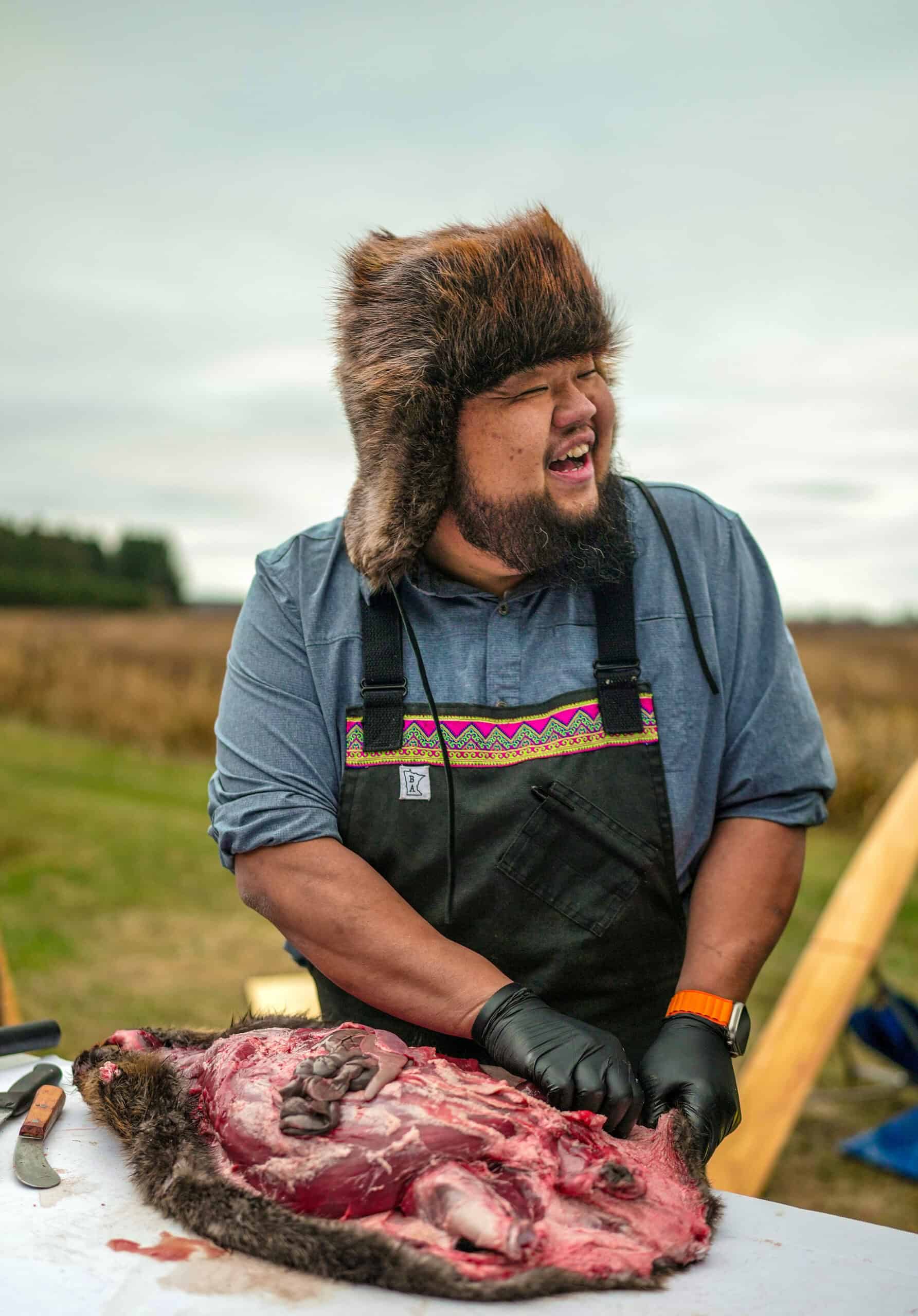


JG: After the Vietnam War, a lot of Vietnamese wound up on the Texas coast, and that made a lot of sense climate-wise — it’s hot, humid, and there’s rice, there’s the shrimping industry. How did the Hmong settle so far north, and what is that like? That’s a massive climate shift for a culture. How has that transition affected food and culture?
YV: The largest diaspora of Hmong people gathered in a metro area is here in the Twin Cities. There are about 92,000 Hmong people here, according to the 2020 census. Let’s back up a little bit. So we have the war. Everybody knows it as the Vietnam War. Well, while the Vietnam War was actually going on in Vietnam, that was the South, what was going up in the North, in the northern part of Laos, is now known as the Secret War.
My dad fought in the war, so he knew land navigation. My mom escaped communist capture, but her first husband was killed in an ambush. She had three kids at that time. They were put in a prison camp. They were there for almost a year on the Laos side. They were able to escape and cross the Mekong River.
Eventually, these little refugee camps were set up. One was set up 10 kilometers off the border of Laos in northern Thailand. And Vinai was where my mom and dad met in ’77. Vinai was open from ’75 to ’92, and hosted 90,000 refugees. Out of those 90,000, 90% of them were Hmong. Out of those 90%, the majority of them end up here in the Midwest. So, Mom and Dad met in the refugee camp. They got married right after, and were there until ’87, ’88. And then we came to the U.S. I was born in ’84. My youngest brother was the only one who was born here in St. Paul. We moved out east for a little bit, then we ended up moving back to Wisconsin, then here to the Twin Cities.
The reason why the Twin Cities area has the largest concentrated Hmong population is that in 1980, the Refugee Relocation Act was passed. There were a lot of nonprofit refugee relocation groups, a lot of them sponsored by Protestant churches, Lutheran churches, and Methodist churches here in this region.
Now, Hmong people, we’re drawn to places where there’s land, where you can farm. We’re agricultural people. That’s why Northern California is such a great spot; any strawberry that you’ve probably eaten, from Northern California all the way up to the Pacific Northwest, is grown by Hmong farmers. Portland has this great big farmer’s market. The number-one flower shop there is owned by my parents’ friends, Hmong farmers. Hmong farmers are moving out to Arkansas, moving out to the Missouri area. Why? Because they’re buying old hog farms, and they’re raising them down there.

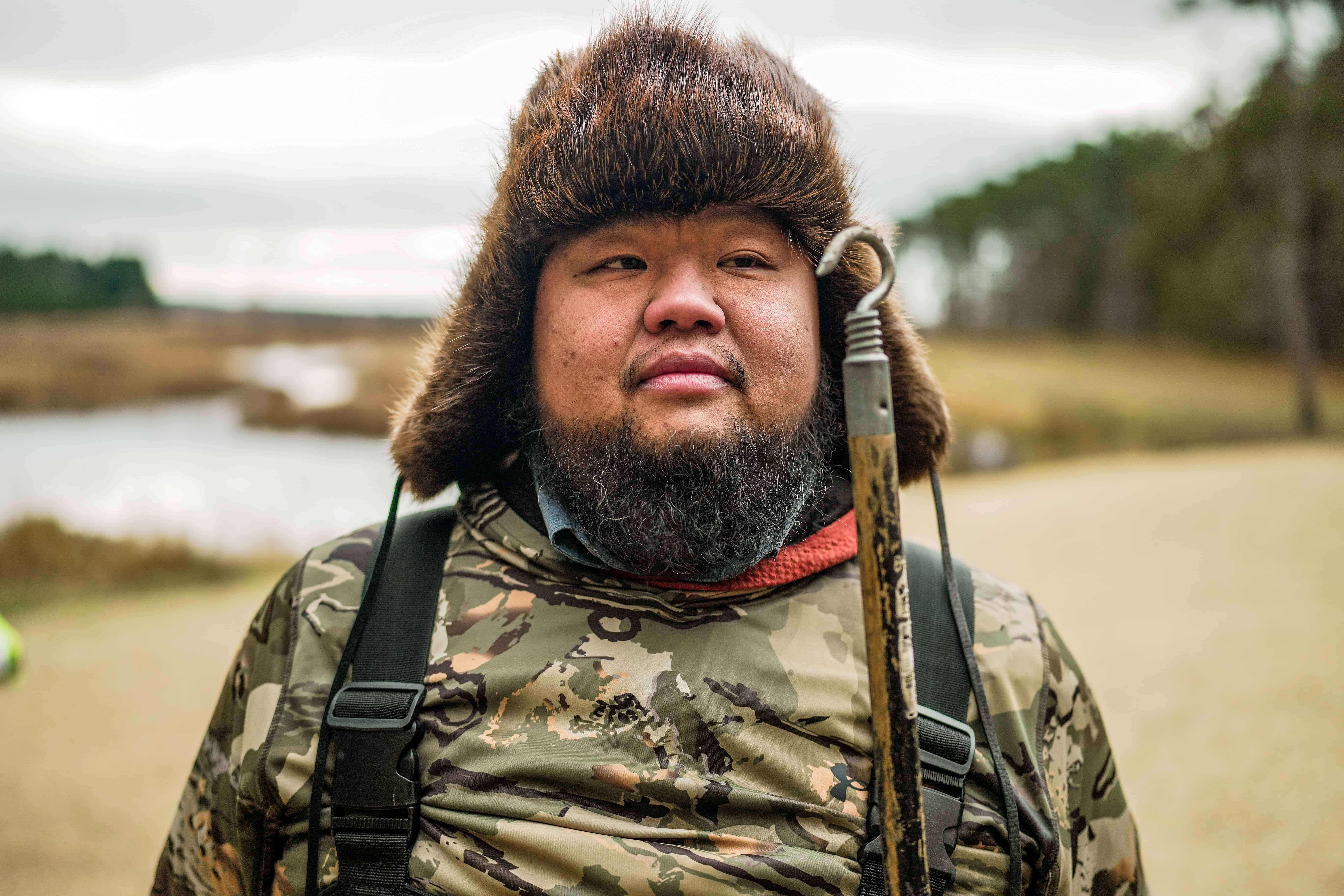
A lot of Hmong kids say, “We don’t have a home,” because we don’t. There’s not a country that we’re from. Even today, Laos doesn’t claim Hmong people as citizens. When I get to talk to Hmong kids, one of the things I say is, “Whenever you feel like you can’t do something because you’re a Hmong, remember who did the government, who did the U.S. come to for their warriors to fight in the mountains of Laos? It was your grandparents. It was your great-grandparents. For some of you, it was your parents. Who did they come to when they needed their soldiers rescued in the jungle? It was our people. And what happened when our people got left behind? They found their way out of the mountain, swam the river, risked their lives and got to America. I always think the blood that pumps through the veins of your grandfather and your grandmother who went through all of that, that’s the same blood that pumps through your heart.”
The thing my mom says to me — because she and my dad’s are the only voices I listen to these days — my mom says, “Anything you’re going through, this will pass.” And when you hear a 70-some-year-old woman who’s been through some of the most horrific genocide say this to you, you’re like, “Hey, maybe it’s not so bad.” So yeah, so that’s for me, Vinai, this restaurant that we have, it’s an homage to my mom and dad, it’s a love letter to them.
JG: I think the last question I asked was very well answered by that. The story you just told really says it: “No, a little cold weather doesn’t bother after all of that.”
YV: Negative 30 is nothing. Watching your family getting dragged in the middle of the village and shot in the head and you can’t do anything about it. Oh, I’ll take negative 30 over that any day. At least I got a jacket on. At least I got heat in my house. Man, perspective.
When my dad got into the refugee camp, he was 24, 25. And then he was there for another 10 years. When I was in my late 20s, I was wondering, “What am I going to do in life?” But then I remembered, “Oh, Dad fought. He lived two lifetimes. He fought a war, got his family here, worked, had to restart all over again, didn’t know the language. He put us all through school. He made sure we were able to go to college. He worked hard so we had no financial issues. And even when we did, he never showed us that he was hurt or anything. He always made sure that we were always helped first. What do I have to complain about?” So if the dishwasher goes out, we’re okay.
JG: The ability to strive beyond difficulty and create food out of necessity, but also out of a sense of beauty — it’s just holding on to a little bit, even through the worst, food can still represent this real beauty. Even if it’s just the act of chopping the pork shoulder, or gathering food from outdoors. There’s a real grounding beauty to that.
There’s not a question in here. I’m just trying to digest that. It’s heartbreaking. But at the same time, just really beautiful and the fact that it can still exist and there’s this flame that exists that is the food throughout. It’s so good and it’s so rooted. I’m blown away by it.
YV: One of the things I always tell people is that when my dad came to this country, he didn’t have land or property or whatever. And what will he leave for his children? For me, that’s why the Hmong sausage is so important, because we watched him make that. That’s Dad right there. I got asked, I don’t know, probably a few years ago, “Hey, would you ever make a vegan version of this?” And I’m like, “No.” Not because I’m against veganism. Not at all. I wouldn’t because it’s not my father’s. This is exactly how my father made it.
Do you know why my dad made it that way? First, when he was a little boy, before the war, his job was to make sure that he tended to that piglet, fed it and took care of it until that piglet grew ready for harvest. And then when we were in the refugee camp, Dad had a part-time job in the butcher hut. He did that because he would get the scraps. And then the scraps, he would be able to bring home to our little hut and make food for our whole family with my grandparents and our family, and all his brothers and his sisters, and they would be able to split it up. So, Dad’s been a butcher his whole life.
For me, when I was growing up, especially in kitchens, there was something about holding that boning knife and breaking down that hog, cutting around that tendon, there was something about it that made me come alive. And what I didn’t realize, until I heard stories from my mom a few years back, was that I felt like I wanted to be like my dad so much that I didn’t realize I had been like him my whole life.
JG: Do you ever go hunting and bring them any of the meat?
YV: Oh, for sure. My parents’ love language is wild game. Once we were working Broken Arrow and we got some wild boar from them, and I sent it over to Mom, and she was like, “Thank you. Your dad and I love it,” and starts sending me pictures.
We send pheasants and squirrels — they love squirrels. I grew up eating squirrels, and that's just the thing we do. The way that people at their church love on each other is like, “You know, we got a couple of squirrels. Come on over. We’ll give you some.” If you bring game meats to them, they will be ever your friend, and they’ll remember you as, “Oh, that’s the wild boar guy. That’s the wild turkey guy.”
When we were on Feral, and we went into iguanas, right? We were down on the floor butchering iguanas, my dad said, “Let me tell you this. When I was a little boy, that’s what we hunted, iguanas in the jungle.” And then he was like, “This is how you make it,” and then he gave me a whole iguana recipe, and I got to do the exact same recipe he did when he was a little boy in the mountains of Laos on the show. It was so awesome. And so, that’s the thing, my parents love that stuff. And now they live out in the country. They have this huge farm where it’s like 10 acres, and everything that they plant and grow on that farm comes to the restaurants.
JG: That’s so beautiful.
When you’re hunting, what do you eat? It can be celebratory, or it could be just how you are trained. But I’m always interested in how hunters eat while they’re hunting — illuminate that.
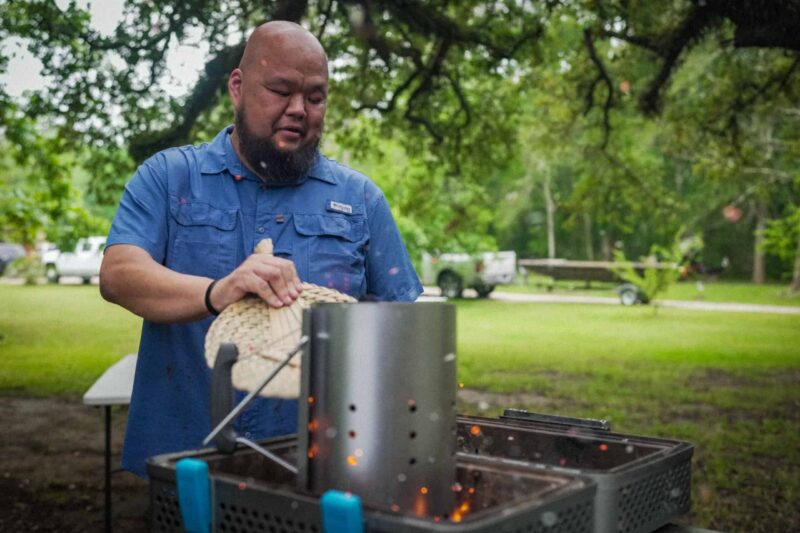
YV: When we’re done at night, let’s play ball, boys. That’s my mentality — is going all out here. Just fire up the grill. And a lot of times we just bring different kinds of meats and a NOMAD grill. We light that bad boy up and rock it out.
JG: If you killed a deer, what does dinner look like?
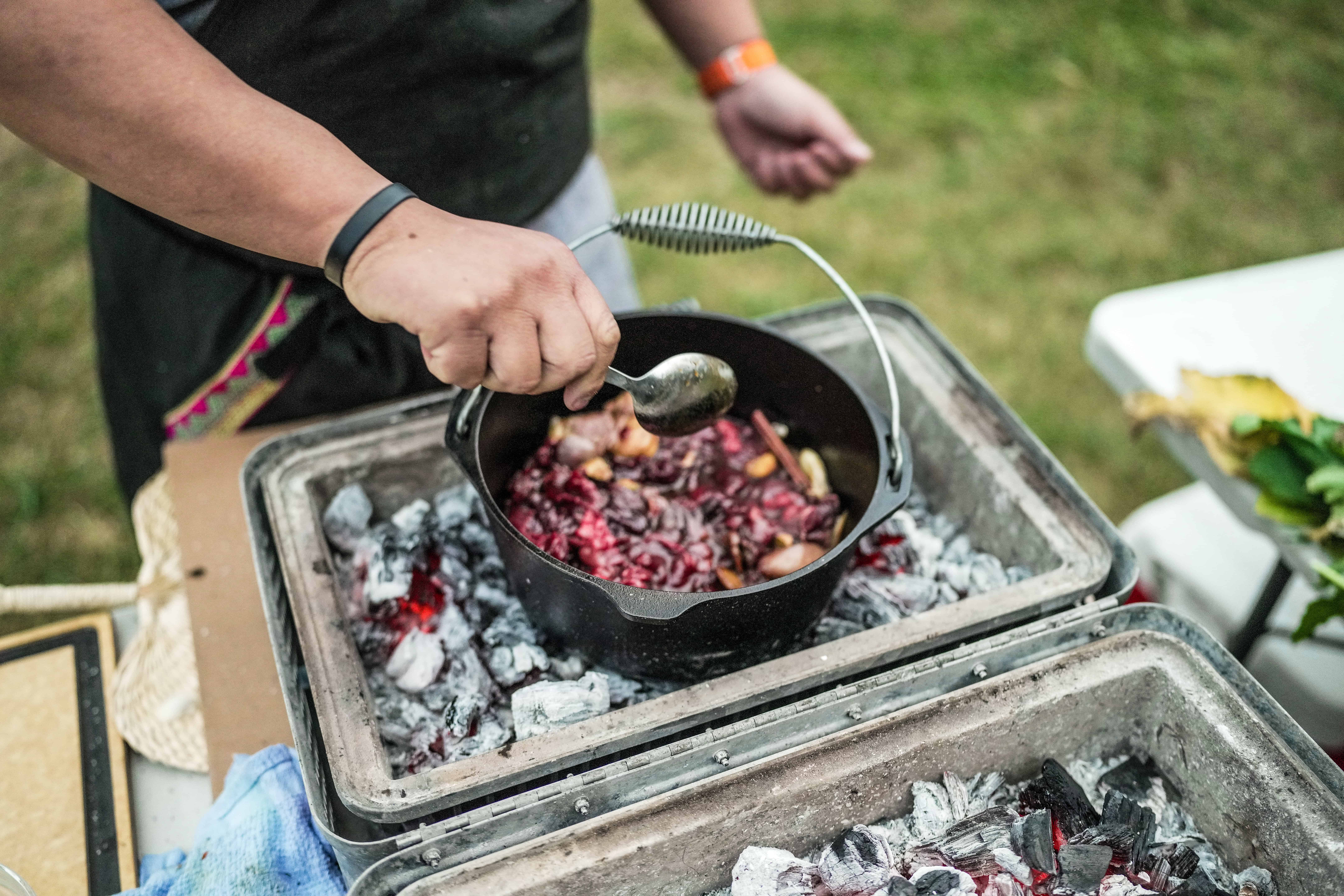
YV: Take some of the tougher cuts, and let’s braise it. Let’s get this bad boy going. Braise it two to three hours on there, fill it up with herbs, lemongrass, ginger, galangal, kaffir lime leaves. Really great aromatics, garlic, and make it into that soup, that stew.
I guess I’m getting old these days, but I love soupy stews. Most of the time when we’re hunting, it’s cold too, so let’s fire up the grill. Let’s get some of that backstrap in there. Grill it off, and it’s an easy dry rub. We always carry sticky rice with some kind of sauce with us. You’re looking at some of the hot sauces my mom makes for us. And then we have vegetables too. When cooking at home for friends and us, it’s super basic. When we get the fire going, we either throw the meat on the fire or in a vessel on the fire.
JG: Are there any ingredients, let’s call them Midwestern ingredients, that you have taken and applied maybe Hmong techniques to?
YV: Absolutely. Yeah. A lot of root vegetables, rutabaga, kohlrabi, because it’s the same thing for us, our people. We use taro, and we use yams. Every country has some root vegetables. But, for me, it’s kohlrabi, radishes, Hakurei radishes. Hmong people, we use a lot of dill now because a lot of that is from Vietnam. Obviously, carrots are a big thing, too. The Hmong people, what we’ve always done is we glean from the cultures around us.
JG: If I had to rank the culinary influences in Texas, being very specific to where I live in central Texas, it’d be in this order: Mexico, Germany, Vietnam. And if you lay all those three out, suddenly you’re like, “This is a great place to eat.”
I mean, not only are they just heavy hitters in my opinion, but they’re also so completely different. They come from different latitudes. They have different techniques and preservation and all that, but they all bring really solid game to the table. And I think that that’s just really fascinating, and how can we not be so thankful for what immigration has done and this conglomeration of different cultures? It makes food really good. If you were to travel, besides your trip next year to Texas to shoot turkeys.
YV: I want to hunt more and different kinds of birds. I’ve done pheasant, duck, Canadian goose, but I would want to hunt more birds. I think that’s fun. I’m not a good shot, so it makes me have to really practice. My buddies have made fun of me about it. “You have a hunting and cooking show and you can’t shoot.”
I’m like, “Hey, man, I want to learn.” I love to hunt, but I’m not an expert huntsman. I’ll be real with that. I’m not trying to fake something. I’ll jokingly say, “I love Under Armor, but I’m not an athlete.”
JG: I always say, “I’m an amazing hunter but a terrible shot.”
YV: But if you can get that meat in front of me, I can cook it. I can figure something out there. So cooking it, you see the process and you’re like, “Well, let’s take it back. Let’s take it another step back.”
It’s a cultural thing, and I want to understand your culture more because I believe that if I’m asking people to understand my culture, I should be willing to walk out there and understand who they are and what they do. In the hunting culture, there are whole subcultures, too. Some people have their own thoughts on bear hunting. Some have their own thought on using dogs. I want to understand it all.
I want to see or hear people talk about that. I’ve been very blessed to be around some of the pheasants and quail guys from Pheasants Forever, and just in that pheasant hunting culture, I learned things about working with dogs I had never seen before.
Like watching your dog, how sometimes the dog is the leader and what it means from pointer dogs to dogs with the beepers and stuff like that. From there, what I love about deer hunting is learning how to shoot and the breathing patterns of shooting. That’s just some of the stuff that I don’t know that I want to learn more about.
I want to get to the ocean to chase bigger game fish. You got your mahi-mahis, your tunas, your big old sea bass. I’d love to get up to Alaska for big game like moose and elk and also do some crabbing. Then, in Maine — being a lobsterman, how does that work?
I think that in the hunting world, there are all these different subcultures, and for me, it’s about the people. It’s actually not even about the hunt. It’s the people around the hunt that I want to get to know.
Just voted one of the top 25 places in the world to eat, Vinai’s Hmong-inspired cuisine can be enjoyed in Minneapolis (for more information visit vinaimn.com). Follow Yia and his work at @yiavang70
Learn more about our Wild Food Editor and Green Michelin Star–winning Dai Due’s owner Jesse Griffiths at
@sac.a.lait