Jason won’t sell you a bottle. In fact, the owner of Passalacqua Winery rarely even talks about wine. Instead, he’ll talk to you about the rodeo, your favorite spots to go hunting, hard work. He’ll ask you to tell him stories about what you’re most proud of, and he wants to talk about the things we make with our hands. Then, suddenly, you’ll realize you’ve finished an entire bottle of red under a tree overlooking vines tucked into the hills of Northern California — a bottle you’ll never forget.
While four generations of farmers and winemakers have helped Passalacqua establish a vision that is crafted around palpable experiences, winemaker Jessica Boone’s expertise is the reason you’ll remember every sip. She’s crafted Passalacqua’s portfolio to be rich but easy drinking — the kind of wine that finds you smiling, forgetting what you were talking about while you parse the flavor notes.
While four generations of farmers and winemakers have helped Passalacqua establish a vision that is crafted around palpable experiences, winemaker Jessica Boone’s expertise is the reason you’ll remember every sip. She’s crafted Passalacqua’s portfolio to be rich but easy drinking — the kind of wine that finds you smiling, forgetting what you were talking about while you parse the flavor notes.
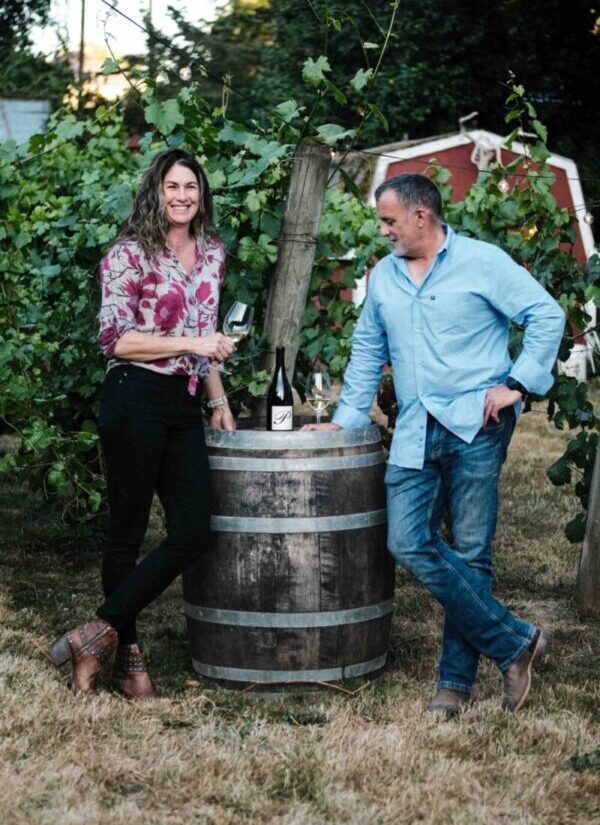
Winemaker Jessica Boone and owner Jason Passalacqua popping open one of their favorite varietals, the Fiano.
The coast’s soil boasts minerality, while Jessica’s 25 years of experience are reflected in well-honed flavors reminiscent of her affection for the terroir: warm and welcoming like the California sun, full and balanced like the shade that spills into the valleys, tannins that pique your interest like a coastal bay, spreading wide across the tongue and settling into the back of your throat. It’s clear her career started with learning from the land itself. Jessica originally worked in wildlife management, where breaks during harvest season aligned with her curiosity. Knowing more about species and water quality than varietals and fermentation, Jessica started as a lab tech in 2000 at a corporate vineyard, helping bottle tens of thousands of barrels annually, and within a few short years made her way to assistant winemaker. It was fervor paired with a sharp sense of taste and a keen understanding of nature that made her the most sensible fit for a winery like Passalacqua, and Jason saw just that.
Jason grew up hunting and fishing and foraging from as far back as he can remember. It’s what led him to his fascination with both land and harvest, and the people you experience both with. He’s the kind of guy who looks back to learn how to move forward, “like the time I sat with my son when he was younger, going through his hunter safety course.” He’s the kind of guy who, when he remembers something he really loves, leans in. “And I’ll always remember how they talked about the evolution of the hunter: the desire to shoot anything and everything, the trophy phase that narrows in your selectivity. Then there’s the experience and conservation phases, the want to sit back and be a part of the thing you’re looking for.” His team is in that third and fourth phase: “You can see that as we partner with folks like Quail Forever or working with Modern Huntsman, we’re creating something that makes people want to experience the outdoors, to protect it so they can continue to enjoy it, the lands we harvest from … We’re building a company that encourages our children to continue to preserve that future.”
Jason grew up hunting and fishing and foraging from as far back as he can remember. It’s what led him to his fascination with both land and harvest, and the people you experience both with. He’s the kind of guy who looks back to learn how to move forward, “like the time I sat with my son when he was younger, going through his hunter safety course.” He’s the kind of guy who, when he remembers something he really loves, leans in. “And I’ll always remember how they talked about the evolution of the hunter: the desire to shoot anything and everything, the trophy phase that narrows in your selectivity. Then there’s the experience and conservation phases, the want to sit back and be a part of the thing you’re looking for.” His team is in that third and fourth phase: “You can see that as we partner with folks like Quail Forever or working with Modern Huntsman, we’re creating something that makes people want to experience the outdoors, to protect it so they can continue to enjoy it, the lands we harvest from … We’re building a company that encourages our children to continue to preserve that future.”
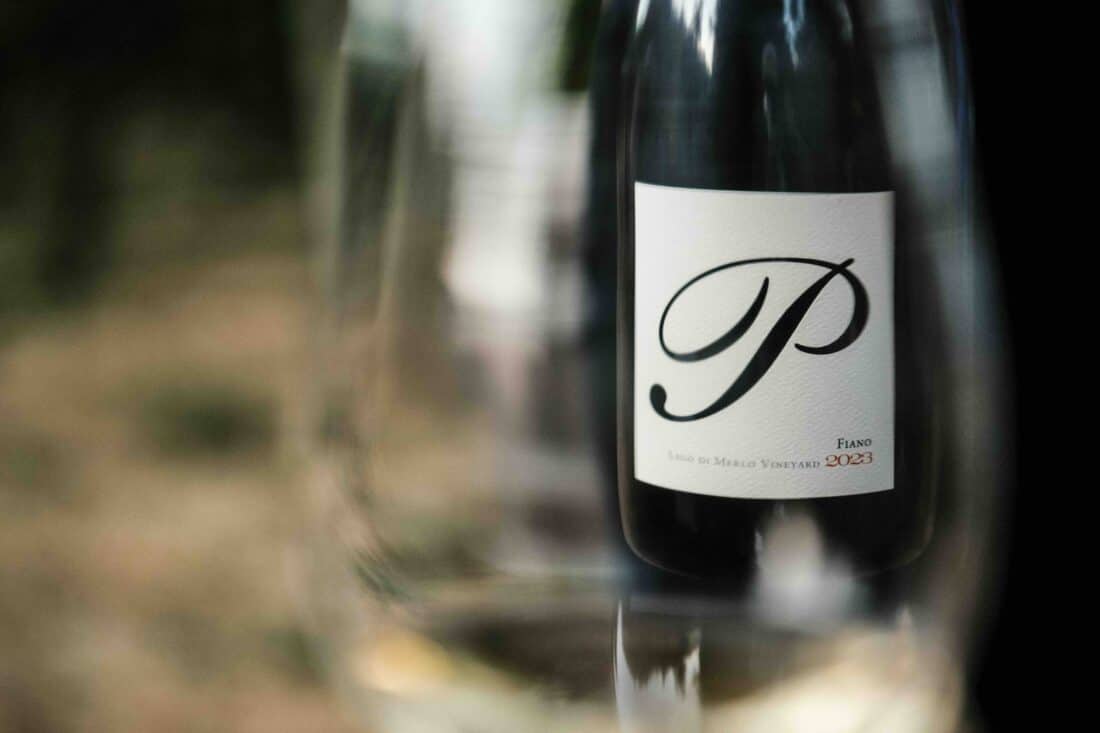
Passalacqua’s Fiano is bright with acidity, with a balanced mouth feel crafted from barrel fermentation in neutral oak. Complex layers of lemon peel, mandarin and almond skin bring a beautiful weight and presence to the palate.
Jason’s hope for what’s ahead stems from how this all started. His great-grandfather immigrated to the U.S. in the 1800s, one of seven brothers. “There’s Passalacquas that stayed on the East Coast. Some jumped off and went down to South America. And then my grandfather came here to Sonoma Country with one or two of his brothers following him out West, and made a winery pre-prohibition.” Jason talks about how his grandfather passed when the winery burned down, leaving a widow and daughter to carry on the tradition of winemaking for another company; how the business skipped a generation and landed in the lap of his father, who has since expanded to growing robust Cabernet vines spread across 120 acres; and how Jason finally started up the winery again after all those years, blending generations of skills together in homage. With such a well-honed history and grapes tenderly cared for, it’s no wonder that Jason brought on someone he boasts about having as brilliant intuition as Jessica Boone, expertly in tune with how collective varietals, skins or clusters, and influencing processes will all play a part. “Once you do something in wine, you can’t undo it. But Jessica sees what it’ll become before it’s even done, she sees what’s evolving.”
You can tell she’s a good winemaker by her focus on the soil’s biodiversity that her grapes grow from, the weather patterns, the barrels, time, and all of the other figurative hands that play a part of the process. Jessica talks about her passion for the land, how Jason’s father and fellow vineyard owners care for the varietals she chooses — they work in a balancing act, finding ways to work around pests and along the contours of hills and treelines, tucking vineyards into corners with enough sun to grow, crafting corridors for animals to continue to enjoy the land without gleaning the grapes — and how they manage minimal watering for both environmental reasons and to help the vines develop a concentrated fruit.
“From the very first harvest, working with the Cabernet from Jason’s family ranch was eye-opening. We worked with Steve Mathieson; back then he was doing more vineyard management and now he has his own label, but he really helped us focus in on that vineyard and get the exact expression of the fruit that we wanted. It was incredible to get these wines that were already great and get them dialed in even more. And then to the Fiano — you know, we make Cabernet, we make Zinfandel, we make Chardonnay, there’s a California standard or Sonoma County standard for all of those. But the Fiano, there’s no background for a California Fiano. Who knows what that should be like? I had the freedom to try. So I decided I was really going to experiment with it all. I did whole cluster natural like we do Chardonnay, I did part of it foot tread and just 24-hour skin contact and then pressed. And then I did full skin contact, like a red wine. All in natural oak. It was so great to see this fruit expressed in different ways, to make three completely different wines. That freedom to try, to take the time to find something we really liked, I think that’s the biggest part about Pair Wild that I enjoy — it gives people the freedom to try things.”
You can tell she’s a good winemaker by her focus on the soil’s biodiversity that her grapes grow from, the weather patterns, the barrels, time, and all of the other figurative hands that play a part of the process. Jessica talks about her passion for the land, how Jason’s father and fellow vineyard owners care for the varietals she chooses — they work in a balancing act, finding ways to work around pests and along the contours of hills and treelines, tucking vineyards into corners with enough sun to grow, crafting corridors for animals to continue to enjoy the land without gleaning the grapes — and how they manage minimal watering for both environmental reasons and to help the vines develop a concentrated fruit.
“From the very first harvest, working with the Cabernet from Jason’s family ranch was eye-opening. We worked with Steve Mathieson; back then he was doing more vineyard management and now he has his own label, but he really helped us focus in on that vineyard and get the exact expression of the fruit that we wanted. It was incredible to get these wines that were already great and get them dialed in even more. And then to the Fiano — you know, we make Cabernet, we make Zinfandel, we make Chardonnay, there’s a California standard or Sonoma County standard for all of those. But the Fiano, there’s no background for a California Fiano. Who knows what that should be like? I had the freedom to try. So I decided I was really going to experiment with it all. I did whole cluster natural like we do Chardonnay, I did part of it foot tread and just 24-hour skin contact and then pressed. And then I did full skin contact, like a red wine. All in natural oak. It was so great to see this fruit expressed in different ways, to make three completely different wines. That freedom to try, to take the time to find something we really liked, I think that’s the biggest part about Pair Wild that I enjoy — it gives people the freedom to try things.”
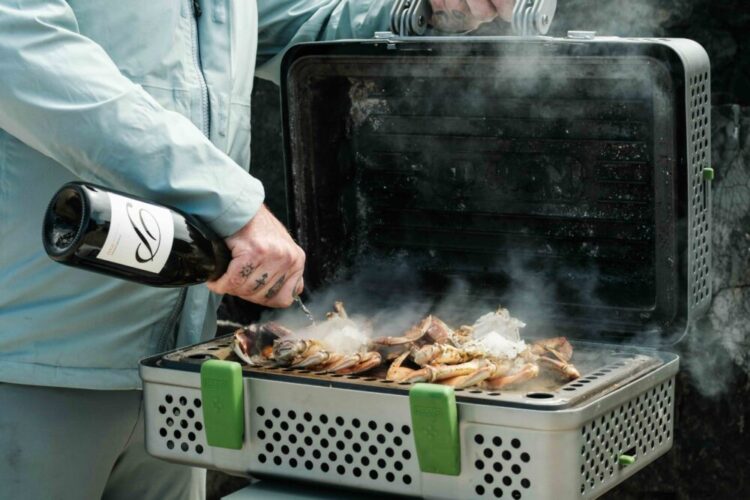
MH Wild Food Editor Jesse Griffiths lends a hand to cook the Dungeness crab with Passlacqua’s Chardonnay.
I’ve had more good wine out of a Solo Cup than a Riedel glass. A lot of it has to do with sitting on the back of the tailgate after a hunt with people who I enjoy. Nothing tastes like how half-stale bread, cheese and salami tastes after a long day. Throw a little good red wine in a plastic cup ... it’s bliss.
Pair Wild is Passalacqua Winery’s collaborative creation between wine and wild food, looking to bring good bottles to the back of tailgates in red Solo Cups. “Or jam jars,” Jessica says. “We just want people to open up the bottle and try it with venison or quail. To give people permission to open up a bottle and just drink it; it doesn’t have to be in a fancy glass.” Jason will tell you that wine is just a beverage. Jessica thinks the wine industry does itself a disservice with its unapproachability, and the Pair Wild program aims to connect those who love the wild with flavors grown from the land they love. “It’s okay to feel however about Cabernet or Merlot. They’re all great varietals. We want people to have more comfortability and confidence with what they’re pairing with wild food.”
Jason recalls, “I was talking with Land Tawney, former head of BHA, and I said ‘Land, I’ve had more good wine out of a Solo Cup than a Riedel glass.’ A lot of it has to do with sitting on the back of the tailgate after a hunt with people who I enjoy. Nothing tastes like how half-stale bread, cheese and salami tastes after a long day. Throw a little good red wine in the Solo Cup, you know, it’s bliss.” And experience is just one of the reasons why Jason brought in wild game chefs and a network of meat purveyors, for those who’ve hit the bottom of the freezer or don’t have the opportunity to lace their boots up at 4 a.m. for a hunt, to work together on the program. “There’s a purity in wild food where you don’t need a lot of marinades or sauces or seasonings. The wines Jessica makes, the tannin levels, the oak levels … all of it complements wild food versus overshadowing or taking over the dish.” Pairing with wild game was a natural decision, and it’s no wonder
Pair Wild is creating the rapidly growing community it is.
Jason recalls, “I was talking with Land Tawney, former head of BHA, and I said ‘Land, I’ve had more good wine out of a Solo Cup than a Riedel glass.’ A lot of it has to do with sitting on the back of the tailgate after a hunt with people who I enjoy. Nothing tastes like how half-stale bread, cheese and salami tastes after a long day. Throw a little good red wine in the Solo Cup, you know, it’s bliss.” And experience is just one of the reasons why Jason brought in wild game chefs and a network of meat purveyors, for those who’ve hit the bottom of the freezer or don’t have the opportunity to lace their boots up at 4 a.m. for a hunt, to work together on the program. “There’s a purity in wild food where you don’t need a lot of marinades or sauces or seasonings. The wines Jessica makes, the tannin levels, the oak levels … all of it complements wild food versus overshadowing or taking over the dish.” Pairing with wild game was a natural decision, and it’s no wonder
Pair Wild is creating the rapidly growing community it is.
Jason’s ethos behind Pair Wild is focused on helping everyone feel connected with something beautifully crafted, through a memorable adventure.
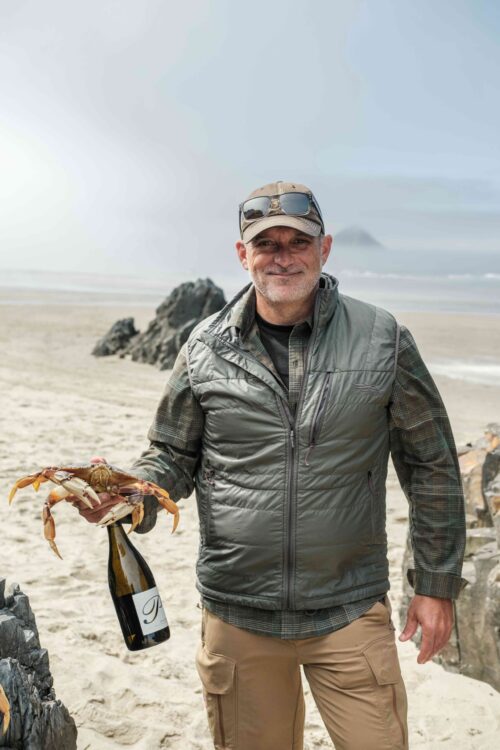
“The Fiano is a varietal that frames flavor. I know, I know, everything comes back to Fiano, but it’s such an amazing example because it goes along with everything. Goes with duck, any upland game, but also fish or like the crab we pulled out of the ocean the other day. The all-natural oak we use helps with those flavors that are bright or briny. Things like that, this inventory of knowledge I’ve been building up, it really changed when we started introducing wild game and foraged pairings,” Jessica says, her words spilling into each other. A full-bodied and well-balanced wine will greet you anytime you uncork one of their bottles, varietals expressed with enthusiasm for every flavor that can be found, in the hope you’re pouring a glass at the end of a day foraging, successful in your hunt. “Even when you go home after the adventure, it doesn’t just stop there. It also kind of starts when you get to tell your loved ones about the experience, about the story. For centuries, these sort of things have been done around the fire, retold on cave walls. And for us, we want you to use our bottle as an excuse to pull out that back strap from the freezer and share it with your friends. When you create that memory with taste and smell and all, you’re developing that memory, you’re encouraging that memory, that bottle becomes something like a sensory detail that affirms it.”
When you walk up to the property in Healdsburg, you’ll find sheds scattered across a porch that wraps around trees and the tasting room, mounts in the bar, and wild game from Jason’s hunt on the table pairing with Jessica’s jams made from the vineyard’s garden.
“We’re not just here to make something good,” Jason says. “We’re here to inspire you to get out in the wild, to strike up a conversation with a stranger while crab fishing, to call up an old friend and ask if they’d like to go hunting.” Because they know that the best flavors are made from hard-working hands and believe the best way to taste craft — the harvest, the fermentation, the considerations along the way — is to pair it with an experience of your own.
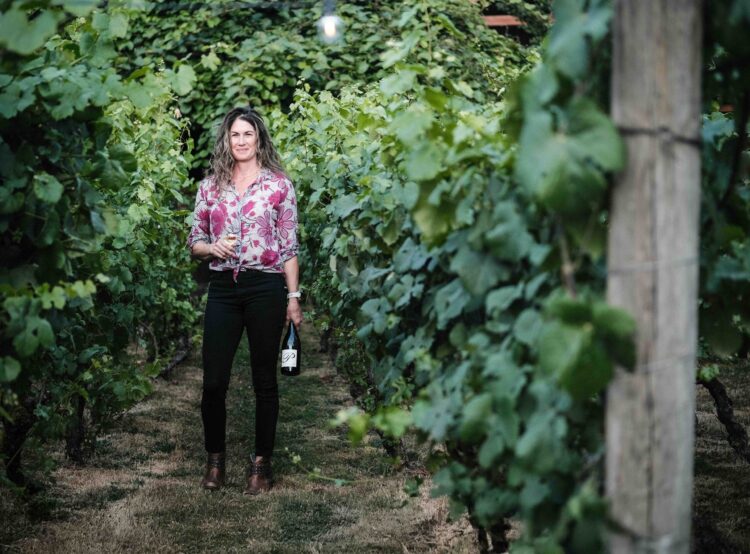
Jessica Boone, Passalacqua’s
winemaker for over a decade, has a
passion for the outdoors paired with
curiosity that drives her to craft bold and
inspirational flavors.
winemaker for over a decade, has a
passion for the outdoors paired with
curiosity that drives her to craft bold and
inspirational flavors.
With the goal to connect audiences directly with producers and adventures, Passalacqua’s bottles are only available from the source. Visit their vineyard in the Sonoma hills or explore their wines at passalacquawinery.com