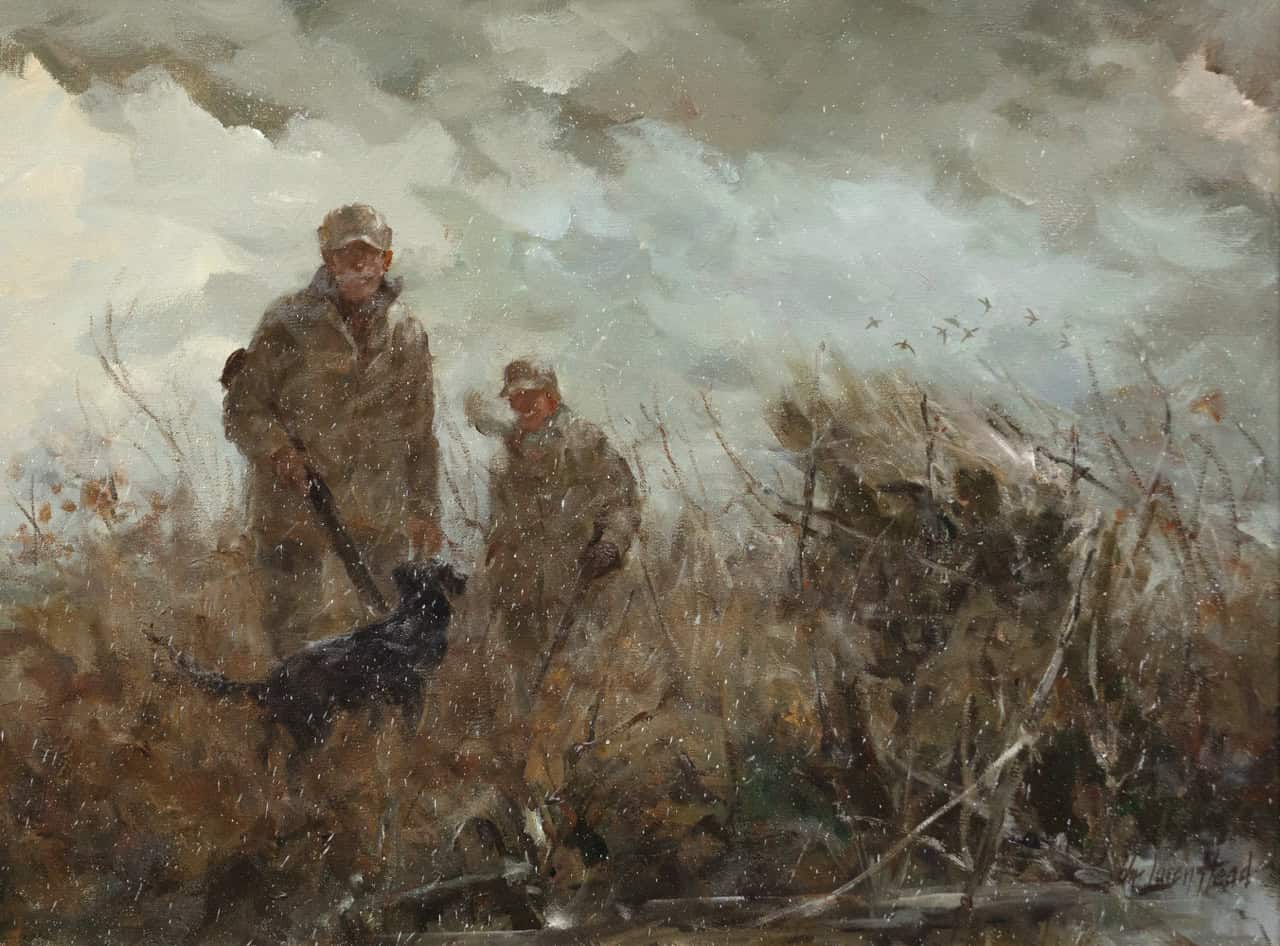
Modern Huntsman and Copley Fine Art Auctions are partnering to share a series of visual essays in art that we hope will inspire and fuel your passion for the hunt.
For as long as humans have had the need for artistic expression, they have had the desire to document nature — the land, the animals, the pursuit. Tracing back this historic lineage to the oldest example of cave art, visual storytelling dated to over 50,000 years ago, we’re presented with a scene of multiple figures and spears surrounding a wild boar, a celebration of the hunt. The continuation of similar scenes, depicted in various formats, can be seen spanning the centuries since. For example, look at the Devonshire Hunting Tapestries: monumentally sized and ornately handwoven textiles from the Medieval period depicting boars, bear, falcons, otters and deer among a grouping of people surrounding the hunt, indicating the social nature of stalking and the joyous celebration that follows. One might say it’s in our nature to depict our nature.
The resurgence of the hunt was seen again in the Baroque period, through artists such as Jean Baptise Oudry and Rubens, masters of light, detail and emotion. Depictions of field sports remained a popular choice for royals and aristocrats in the 17th and 18th centuries, and by the 19th century, with the pursuit of the American West, this tradition found new ground, widening the audience for sporting and wildlife art across both artists and collectors. And this is where (although not when) Copley Fine Art Auctions enters the story.
Founded in 2005, auction house Copley has carved out its perfect niche: a blend of American bird carvings, folk art, and 19th- and 20th-century American sporting and wildlife paintings. Each year, Copley releases two catalogs totaling nearly 300 pages each. These beautifully produced auction catalogs are filled with works for sale by both deceased and living artists.
With any great hunter comes a reliance on attention to detail, and the Copley group epitomizes this ethos. From their appreciation of intricate vermiculation patterns of carved decoys, to understanding the way a canoe gliding through the water should be depicted on a canvas, the Copley art team of Steve O’Brien Jr., owner, Leah Tharpe, Colin McNair and Ben Davenport maintains extremely high standards.
“We would not be able to do what we do if we weren’t passionate fishermen, duck hunters, birders, deer hunters, carvers and historians,” says O’Brien Jr.
This same appreciation of the hunt that lies at the heart of Copley’s curation resonates deeply with Modern Huntsman’s core storytelling beliefs. Together, we celebrate these artistic pursuits with our audiences.
Our goal is to transport selected offerings from Copley’s catalogs through the pages of this book and our online print shop, helping the world connect with the hues and textures that give ode to the past and inspire our future, in your hands or on your walls, and in the field.
The resurgence of the hunt was seen again in the Baroque period, through artists such as Jean Baptise Oudry and Rubens, masters of light, detail and emotion. Depictions of field sports remained a popular choice for royals and aristocrats in the 17th and 18th centuries, and by the 19th century, with the pursuit of the American West, this tradition found new ground, widening the audience for sporting and wildlife art across both artists and collectors. And this is where (although not when) Copley Fine Art Auctions enters the story.
Founded in 2005, auction house Copley has carved out its perfect niche: a blend of American bird carvings, folk art, and 19th- and 20th-century American sporting and wildlife paintings. Each year, Copley releases two catalogs totaling nearly 300 pages each. These beautifully produced auction catalogs are filled with works for sale by both deceased and living artists.
With any great hunter comes a reliance on attention to detail, and the Copley group epitomizes this ethos. From their appreciation of intricate vermiculation patterns of carved decoys, to understanding the way a canoe gliding through the water should be depicted on a canvas, the Copley art team of Steve O’Brien Jr., owner, Leah Tharpe, Colin McNair and Ben Davenport maintains extremely high standards.
“We would not be able to do what we do if we weren’t passionate fishermen, duck hunters, birders, deer hunters, carvers and historians,” says O’Brien Jr.
This same appreciation of the hunt that lies at the heart of Copley’s curation resonates deeply with Modern Huntsman’s core storytelling beliefs. Together, we celebrate these artistic pursuits with our audiences.
Our goal is to transport selected offerings from Copley’s catalogs through the pages of this book and our online print shop, helping the world connect with the hues and textures that give ode to the past and inspire our future, in your hands or on your walls, and in the field.
63. Lynn Bogue Hunt (1878-1960)
The ‘Pilar’ Fights a Blue Marlin Off Cuba North Coast, Ernest Hemingway, 1940
oil on canvas, 22 by 18 in.
“You killed him for pride and because you are a fisherman. You loved him when he was alive and you loved him after. If you love him, it is not a sin to kill him.” – The Old Man and the Sea
The ‘Pilar’ Fights a Blue Marlin Off Cuba North Coast, Ernest Hemingway, 1940
oil on canvas, 22 by 18 in.
“You killed him for pride and because you are a fisherman. You loved him when he was alive and you loved him after. If you love him, it is not a sin to kill him.” – The Old Man and the Sea

The Pilar was a pillar of support for 27 years of Hemingway’s life, a vessel that carefully navigated the seas as he carefully navigated his pen across paper. From 1934 until his death in 1961, he helmed countless expeditions, research patrols and marine life chases across the striking blue waters of Florida, Cuba and the Bimini Islands.
An act of class, the Pilar sits elegantly atop the rich cerulean shades of the water, striking bouts of color and aquamarine hues. While it’s hard to believe that these vivid details could be true, there’s a sense of transparency, a knowledge that the world under the surface is teeming with brilliant shades of scales and fins. Met with this, in a celadon flash, sea foam sprays across the bottom corner of the photo, where a blue marlin speeds by. A thrill, a chase, not to be forgotten.
Perfectly composed in terms of visual structure, The ‘Pilar’ Fights a Blue Marlin Off Cuba North Coast manages to blend action, placidity and nostalgia in rich forms of contrast, both visually and emotionally: colorblocked areas of billowing clouds fade into the background, while the carefully outlined details of the boat and the marlin provide visual interest long past the coastline. An adept illustrator and fine artist, contributing to magazines such as Field & Stream and Sports Afield, Hunt successfully captures here the intensity of the ocean and the chase.
From the Copley Catalog: Lynn Bogue Hunt was born in rural Honeoye Falls, New York, into a family that ran a small sawmill operation. He grew up with modest means, but spent hours outside exploring the natural surroundings in the woods near his home. He often collected birds and practiced taxidermy, a hobby that led to his accurate portrayal of his wildlife subjects.
An act of class, the Pilar sits elegantly atop the rich cerulean shades of the water, striking bouts of color and aquamarine hues. While it’s hard to believe that these vivid details could be true, there’s a sense of transparency, a knowledge that the world under the surface is teeming with brilliant shades of scales and fins. Met with this, in a celadon flash, sea foam sprays across the bottom corner of the photo, where a blue marlin speeds by. A thrill, a chase, not to be forgotten.
Perfectly composed in terms of visual structure, The ‘Pilar’ Fights a Blue Marlin Off Cuba North Coast manages to blend action, placidity and nostalgia in rich forms of contrast, both visually and emotionally: colorblocked areas of billowing clouds fade into the background, while the carefully outlined details of the boat and the marlin provide visual interest long past the coastline. An adept illustrator and fine artist, contributing to magazines such as Field & Stream and Sports Afield, Hunt successfully captures here the intensity of the ocean and the chase.
From the Copley Catalog: Lynn Bogue Hunt was born in rural Honeoye Falls, New York, into a family that ran a small sawmill operation. He grew up with modest means, but spent hours outside exploring the natural surroundings in the woods near his home. He often collected birds and practiced taxidermy, a hobby that led to his accurate portrayal of his wildlife subjects.
314. Harry C. Edwards (1868-1922)
Remington Arms Advertising Poster, 1914
lithograph, 26 ¼ by 18 in.
Remington Arms Advertising Poster, 1914
lithograph, 26 ¼ by 18 in.
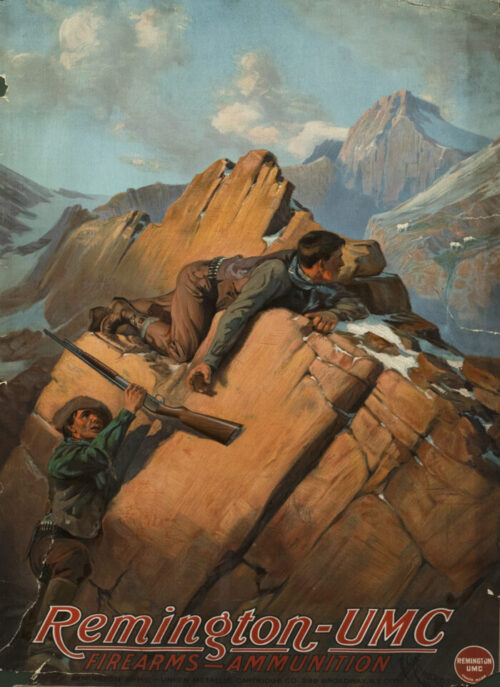
Classically trained in wildlife and Western-themed paintings, Harry C. Edwards created a career providing illustrations for large-circulation magazines at the time. With an intersection of these two skills, Edwards thrived during a golden age of advertising, an era in which the product wasn’t the selling point but rather the necessary element in storytelling.
Combining the classic typography of the Remington UMC brand with traditional Western painting techniques, Edwards was able to capture light elegantly dancing across a ridge where two hunters are precariously perched. Without the helping hand of his fellow hunter or the precision of the Remington, this shot of a lifetime may never have come to fruition. While the game prize is not depicted, the viewer still holds their breath in anticipation.
From the Copley Catalog: After A Chancey Shot, painted by Harry C. Edwards (1868-1922), depicting a pair of sheep hunters in the high country, published for Remington Arms.
Combining the classic typography of the Remington UMC brand with traditional Western painting techniques, Edwards was able to capture light elegantly dancing across a ridge where two hunters are precariously perched. Without the helping hand of his fellow hunter or the precision of the Remington, this shot of a lifetime may never have come to fruition. While the game prize is not depicted, the viewer still holds their breath in anticipation.
From the Copley Catalog: After A Chancey Shot, painted by Harry C. Edwards (1868-1922), depicting a pair of sheep hunters in the high country, published for Remington Arms.
194. Brett James Smith (b.1958)
Back with Meat
oil on canvas, 24 by 30 in.
Back with Meat
oil on canvas, 24 by 30 in.

With an ephemeral application of oil on canvas, Brett James Smith utilizes his illustrative background to capture the stories of the hunters, anglers and adventurers he found in the wild. Smith has quite a depth of knowledge in the sporting field, and his career took off through the authenticity depicted in his game hunts, with covers that have graced Gray’s Sporting Journal, Ducks Unlimited and more.
Here, descending down a glaze of freshly applied snow, the lone hunter indulges in a moment of reflection with horse and mule in stow, indicative of a long journey to procure an elk in preparation for the cold winter months. The hazy butter yellows and slate grays of the sky complement the small windows of the log cabin below, ablaze with warmth and welcome.
From the Copley Catalog: Brett J. Smith was born on March 19, 1958, in New Orleans, Louisiana. His early introduction to sporting art came from his father, who worked professionally as an illustrator and moonlighted as a fine artist, contributing paintings for covers of the early outdoor and Western magazines.
Sportsmen nationwide collect Smith’s work because it is not only visually exciting, but also authentic and brings to bear his intimate knowledge of his sporting experiences.
Here, descending down a glaze of freshly applied snow, the lone hunter indulges in a moment of reflection with horse and mule in stow, indicative of a long journey to procure an elk in preparation for the cold winter months. The hazy butter yellows and slate grays of the sky complement the small windows of the log cabin below, ablaze with warmth and welcome.
From the Copley Catalog: Brett J. Smith was born on March 19, 1958, in New Orleans, Louisiana. His early introduction to sporting art came from his father, who worked professionally as an illustrator and moonlighted as a fine artist, contributing paintings for covers of the early outdoor and Western magazines.
Sportsmen nationwide collect Smith’s work because it is not only visually exciting, but also authentic and brings to bear his intimate knowledge of his sporting experiences.
407. King Powder Co. (1850-1958)
Quick Shot
lithograph, 23 ½ by 17 in.
Quick Shot
lithograph, 23 ½ by 17 in.

To capture an animal flying is one feat, to capture it falling is another. The great mallard, a sight to see when swimming, diving, flying, somehow manages to depict elegance despite the instant impact he faces — a mouth agape before he plunges into the water, awaiting the moment of retrieval. Utilizing the loose-flowing nature of watercolors, this piece manages to capture the hazy morning sky while showcasing the detailed contrast of rich, green neck plumage against earthy browns and milky whites. An out-of-focus hunter stands perched at the bank, shotgun still against his shoulder, admiring the way gravity pulls the mallard into the calm morning water. A Quick Shot, indeed.
From the Copley Catalog: Depicting a mallard drake and the successful hunter, this image graced many King Powder Co. tins. Printed by the Strobridge Litho Company of Cincinnati, Ohio.
From the Copley Catalog: Depicting a mallard drake and the successful hunter, this image graced many King Powder Co. tins. Printed by the Strobridge Litho Company of Cincinnati, Ohio.
561. Harry Curieux Adamson (1916-2012)
Canada Geese in Flight
oil on canvas, 19 by 25 in.
Canada Geese in Flight
oil on canvas, 19 by 25 in.

Harry Curieux Adamson is able to capture the rare poetry of geese, their magnificence in flight. With sprawling wingspans, each bends at a slightly different angle, each arc creating a counterpoint to the one beside it. Despite the subtle variation, this flock moves with quiet intention, arranging themselves deliberately, an ode to unspoken choreography that is gently written in air and instinct. While the light’s reflections are carefully captured on the nape of the animals’ necks and the tips of their wings, the striking sea of clouds behind shares the spotlight. A true representation of blending skill: dark slate blues gently fade into shades of blue-green and are adorned with rich whites and apricot hues, gently mimicking the sun rays.
From the Copley Catalog: Harry Adamson was one of the premier waterfowl painters of the last 50 years. Born in Seattle in 1916, he studied under Paul J. Fair, who is best known for his wildlife photography.
Adamson began painting after serving in World War II, selling a painting to the president of Mexico within the first decade of his career. His success continued, and he was honored as the first California Waterfowl Association Artist of the Year, as well as the 1979 Ducks Unlimited Artist of the Year. His works have been included in shows at the Smithsonian American Art Museum, the British Museum and the Carnegie Museum of Natural History. Admired by his fellow artists, Adamson had a knack for capturing birds in their natural habitats, including the sky.
From the Copley Catalog: Harry Adamson was one of the premier waterfowl painters of the last 50 years. Born in Seattle in 1916, he studied under Paul J. Fair, who is best known for his wildlife photography.
Adamson began painting after serving in World War II, selling a painting to the president of Mexico within the first decade of his career. His success continued, and he was honored as the first California Waterfowl Association Artist of the Year, as well as the 1979 Ducks Unlimited Artist of the Year. His works have been included in shows at the Smithsonian American Art Museum, the British Museum and the Carnegie Museum of Natural History. Admired by his fellow artists, Adamson had a knack for capturing birds in their natural habitats, including the sky.
315. Ogden M. Pleissner (1905-1983)
Blue Boat on the St. Anne, 1959
color print, 14 ¾ by 22 ¾ in.
Blue Boat on the St. Anne, 1959
color print, 14 ¾ by 22 ¾ in.
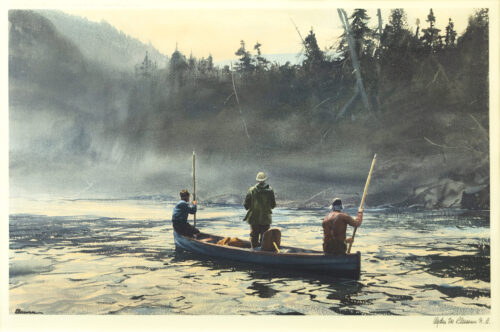
Spending time between Brooklyn, New York, and Dubois, Wyoming, artist Ogden M. Pleisser had the unique opportunity to showcase work in notable spaces such as the Metropolitan Museum of Art, while also spending the serenity of summer repeatedly casting lines into the snaking curves of the Wind River. While he was classically trained, his landscape work took an alternate approach — there’s a sheer joy to be found in the expressive brushstrokes in conjunction with hazy flows of color in the background. It’s an equally elegant and raw depiction of the three men on a small boat; one can imagine them carefully stalking the perfect pool of water, eyes eager with anticipation.
From the Copley Catalog: Considered by many to be the most desirable of Pleissner’s prints, the original painting resides at the Shelburne Museum in Vermont.
From the Copley Catalog: Considered by many to be the most desirable of Pleissner’s prints, the original painting resides at the Shelburne Museum in Vermont.